STSDSD Exit Exam Mock - Questions and Answers Set 1
By NIRZARA TEAM
Published: Apr 16, 2026 at 9:39 pm
Share:
MARINE EXAM
15 min read
STSDSD Exit Exam Mock - Questions and Answers Set 1
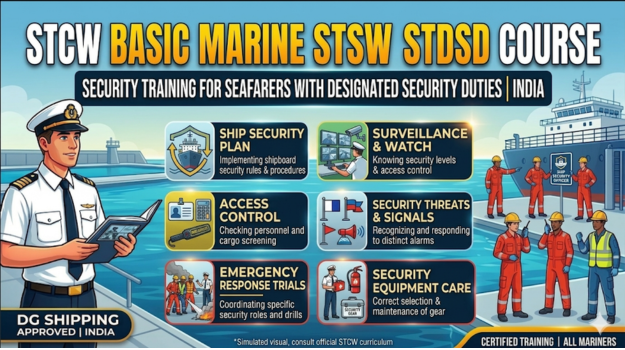
With the constant global threat of piracy, cargo theft, and unauthorized boardings, maintaining a hardened security posture on commercial vessels is a non-negotiable aspect of modern seafaring. Every mariner assigned specific security duties must fully understand the legal and operational frameworks that protect a ship at sea and in port. To help you build this foundational knowledge, Nirzara introduces the STSDSD Exit Exam Mock - Questions and Answers Set 1. This debut practice module focuses heavily on the basic architecture of the ISPS Code, identifying security threats, and understanding Maritime Security (MARSEC) Levels.
This foundational set on Nirzara contains 30 highly repeated Multiple Choice Questions (MCQs) mapped precisely to the latest DG Shipping online exam portal. You will face essential STCW questions regarding the distinct roles of the Ship Security Officer (SSO) and Company Security Officer (CSO), the differences between Security Levels 1, 2, and 3, and basic access control protocols at the gangway. Because misidentifying a security threat can compromise the safety of the entire crew, the computer-based exam evaluates these basic definitions and legal mandates very strictly.
Every question inside Nirzara's Set 1 features its direct, verified correct answer, offering an instant assessment of your security awareness. The DG Shipping exit portal frequently relies on core ISPS principles to check your accuracy under pressure. Spend a few minutes solving these 30 targeted questions today on Nirzara to iron out your foundational doubts, sharpen your answering speed, and securely pass your security exam on the very first try!
Practice with 30 questions from the BASIC STSDSD COURSE bank. Each question is verified and explained.
MCQ Practice Questions (30)
Live Mock TestQuestion 1 / 30
Time Left: 15:00
Loading question...
🎉 Mock Test Complete
Your Examination Result
0 / 30
Score Percentage: 0%
Correct
0
Incorrect
0
Skipped
0
1
What is the below is not included in CSR record
aThe Master Name
bThe details of the authority auditing the vessel for DOC and SMC
cThe details of classification society
dThe details of the bareboat charterer
Correct Answer: Option A
The Continuous Synopsis Record (CSR) is designed by SOLAS Chapter XI-1, Regulation 5, to provide a ship's continuous administrative history, focusing on stable details such as ownership, flag state, ISM Company, and classification/auditing authorities. The Master's name is not included because this personnel information changes frequently and does not represent a static element of the ship's fundamental identity or regulatory compliance history. Details regarding classification societies, auditing authorities for ISM/ISPS, and bareboat charterers are integral to the ship's operational and regulatory identity, making their inclusion necessary.
2
The following part of ISPS is mandatory:
aPart A
bPart B
cPart C
dPart D
Correct Answer: Option A
The International Ship and Port Facility Security (ISPS) Code, as mandated by SOLAS Chapter XI-2, establishes that Part A contains the binding, mandatory provisions that all contracting governments and ships must implement. Part B, conversely, offers guidance and recommended practices, not enforceable regulations.
3
Following is not part of security incident response team
aPort Security Team
bShips Security Personal
cSSO
dFire Team
Correct Answer: Option D
The Fire Team is specifically designated and trained under SOLAS Chapter II-2 and STCW standards for fire prevention and firefighting operations. A ship's security incident response team, mandated by the ISPS Code and SOLAS Chapter XI-2, consists of the SSO and ship's security personnel responsible for addressing security threats, breaches, and implementing the Ship Security Plan. Therefore, their distinct roles and training differentiate a Fire Team from personnel primarily dedicated to security incident response.
4
The ISPS code applies to vessel over 500 GRT on international voyage :
aTrue
bFalse
Correct Answer: Option A
The ISPS Code, specifically mandated under SOLAS Chapter XI-2, applies unequivocally to all passenger ships and cargo ships, including high-speed craft, of 500 gross tonnage and upwards engaged on international voyages. This requirement is a cornerstone of the global maritime security regime, ensuring vessels and port facilities maintain robust security measures. Therefore, the statement is indeed correct.
5
The PSP should provided procedures for evacuation to ships staff in case of security threats or breaches of security.
aTrue
bFalse
Correct Answer: Option A
The Ship Security Plan (SSP), as required by SOLAS Chapter XI-2 and the International Ship and Port Facility Security (ISPS) Code, is a comprehensive document that must detail all measures and procedures for the ship's security. A fundamental component of any effective SSP is the inclusion of clear, actionable procedures for the evacuation of ship's staff in the event of security threats or breaches. This ensures the safety of life at sea, which is paramount in all maritime operations and emergency preparedness.
6
How frequently we need to calibrate the security equipment
aEvery Month
bEvery three Months
cAs per the manufacturers instructions
dOn breakdown
Correct Answer: Option C
Calibration intervals for security equipment are dictated by the manufacturer's recommendations and operational guidelines. Adhering to these instructions ensures the equipment functions correctly and meets regulatory compliance requirements. Therefore, calibration should occur as per the manufacturer's instructions to guarantee optimal performance and security.
7
"Under ISPS code describes the current scenario related to the security threat to the country and its coastal region including the ships visiting that country"
aExchange rate
bGDP
cDaily news channels
dSecurity levels
Correct Answer: Option D
Under the ISPS Code, "Security levels" (Level 1, 2, or 3) are the precise and formal mechanism designated by Contracting Governments to describe the current security threat scenario for a country, its coastal region, and all ships and port facilities within its jurisdiction. These levels directly communicate the degree of risk of a security incident and mandate specific, corresponding security measures to be implemented by ships and port facilities. This standardized system ensures an appropriate and coordinated response to evolving maritime security threats.
8
You find suspicious object on the deck , what action will you take
aThrow it overboard
bInform the master immediately on radio
cMove all personnel as far away from the object as possible
dNone of the above
Correct Answer: Option C
Upon discovering a suspicious object, the immediate and paramount action is to ensure the safety of all personnel. Option C correctly prioritizes the preservation of life, a fundamental principle enshrined in maritime safety regulations such as SOLAS and STCW, by establishing a safe distance to mitigate any potential harm. Subsequent actions, such as informing the Master and initiating emergency protocols, must only follow this critical initial measure to protect human life.
9
As per ISPS code it is compulsory for the company security officer to visits company ship at every port.
aYes
bNo
cSome times yes
dSome times no
Correct Answer: Option B
The ISPS Code does not mandate that the Company Security Officer (CSO) physically visits every company ship at every port. While the CSO is responsible for ensuring the development, implementation, and periodic review of ship security plans, this critical oversight can be achieved through various methods, and the Code does not specify a requirement for such frequent physical presence. The CSO's role focuses on the overall effectiveness and compliance of the company's security program, not continuous shipboard presence in every port call.
10
Familiarization of SSP is required for :
aMaster
bSSO
cAll crew members
dNone of the above
Correct Answer: Option C
Familiarization with the Ship Security Plan (SSP) is mandatory for all crew members, as stipulated by the ISPS Code under SOLAS Chapter XI-2. This ensures that every individual onboard understands their specific roles, responsibilities, and the procedures necessary to maintain the vessel's security posture and effectively respond to security threats. Collective awareness and active participation from the entire crew are fundamental to robust maritime security, reinforcing compliance with international standards.
11
What is not included in SSI(likely expansion Ship Security Inspection
aSecurity program
bTechnical details of the screening equipment
cShips cargo plan
dLocation of SSAS
Correct Answer: Option C
The Ship's Cargo Plan primarily details cargo stowage for ship stability, trim, and operational efficiency, falling under operational and navigational management, not directly within the scope of a Ship Security Inspection (SSI). An SSI, as mandated by SOLAS Chapter XI-2 and the ISPS Code, focuses on security vulnerabilities, access control, security equipment functionality (like SSAS or screening equipment), and the implementation of security procedures. While security personnel verify cargo integrity against manifests, the technical specifics of the stowage plan itself are not a direct component of a security assessment.
12
For security we have to secure escape route doors:
aYes
bNo
cSome time Yes
dSome time No
Correct Answer: Option B
Escape route doors must never be secured in a manner that obstructs or impedes egress, as this is a fundamental requirement under SOLAS Chapter II-2 and various Flag State regulations for ensuring rapid and safe evacuation in emergencies. While security is paramount, it must not compromise the ability of personnel to escape freely and immediately from any space, meaning emergency exits must always be readily operable from the inside without the need for a key. Any security measure implemented on an escape route must ensure it remains instantly releasable for safety.
13
Which of the following elements are tested during ship shore security drill
aThese exercises shall check the availability of security resources
bThese exercises shall check the availability of safety resources
cThese exercises shall check the availability of sailing resources
dThese exercises shall check the availability of social resources
Correct Answer: Option A
Ship-shore security drills, as mandated by the ISPS Code under SOLAS Chapter XI-2, are fundamentally conducted to evaluate the effectiveness of the Ship Security Plan and the preparedness of the crew and vessel to respond to security threats. A paramount element of this evaluation is to verify the availability, operability, and proper deployment of all designated security resources, including security equipment, communication systems, and trained personnel. Therefore, checking the availability of security resources is a primary objective of these essential exercises.
14
If the ship is on higher security level than the port:
aThe ship will lower its security level
bThe ship will maintain its security level and sign the DOS
cThe ship will call CSO and ask what to do
dThe ship will call flag and ask what to do
Correct Answer: Option B
Under the ISPS Code, a ship must never operate at a security level lower than that of the port facility. Therefore, if the ship is already at a higher security level, it is imperative to maintain that heightened posture to ensure adequate protection. Concurrently, a Declaration of Security (DOS) must be signed between the ship and port facility to establish agreed security measures for their interface, aligning all parties with the higher standard.
15
What is the operation limitation of a security equipment like Radio:
aRadio can be loud.
bRadio can be low.
cRadio signal can be jammed.
dNone of the above.
Correct Answer: Option C
Radio signals are essential for maritime safety and security, as mandated by SOLAS Chapter IV and GMDSS regulations. The most critical operational limitation for security equipment like a radio is the potential for signal jamming, which intentionally or unintentionally interferes with or blocks vital communication channels. This disruption directly compromises a vessel's ability to transmit distress alerts, receive navigation warnings, and maintain secure communication, thereby severely impacting maritime safety and security operations.
16
The PMSC shall maintain insurance cover for themselves:
aTrue
bFalse
Correct Answer: Option A
A Private Maritime Security Company (PMSC) is unequivocally required to maintain comprehensive insurance coverage for its operations, personnel, and all associated liabilities. This is a critical aspect of maritime safety and risk management, ensuring professional conduct and adequate provision for potential incidents. Such coverage is a fundamental requirement imposed by Flag States and industry best practices for any entity providing security services at sea.
17
STSDSD means:
aSafety training for seafarers for designated safety duties.
bSafety training for seafarers for designated security duties.
cSecurity training for seafarers for designated security duties.
dSecurity training for seafarers for designated safety duties.
Correct Answer: Option C
STSDSD stands for Security Training for Seafarers with Designated Security Duties, as mandated by the International Ship and Port Facility Security (ISPS) Code and further detailed within STCW Code Section A-VI/6. This certification ensures seafarers understand their responsibilities in maintaining ship security and responding to security threats. Proper implementation of STSDSD is crucial for overall maritime security and compliance with international regulations.
18
Separate embarkation and disembarkation provisions
aOn Passenger vessels
bOn Gas carriers
cOn chemical tankers
dNot provided on any ships
Correct Answer: Option A
Separate embarkation and disembarkation provisions are specifically required on passenger vessels to ensure the safe, efficient, and orderly flow of a large number of persons. This critical design and operational feature minimizes congestion, reduces the risk of accidents, and is a fundamental aspect of maritime safety standards governing passenger ship operations and emergency preparedness, implicitly covered by SOLAS requirements for safe access and egress.
19
The ships security assessments must include the following
aThe perceived threat to ship & the consequences of an incidents
bThe port she visits
cThe cargo she carries
dThe nationality of the crew onboard
Correct Answer: Option A
The Ship Security Assessment (SSA), mandated by SOLAS Chapter XI-2 and the ISPS Code, is a comprehensive risk analysis that fundamentally requires identifying potential security threats to the vessel and evaluating the consequences of any security incident. This systematic assessment of perceived threats and their potential impact informs the development of effective security measures and the Ship Security Plan. Therefore, understanding both the nature of threats and the severity of their outcomes is paramount to a compliant and effective security assessment.
20
Maritime security measures does not apply to
aOffshore activities
bTerritorial sea
cEEZ
dContinental shelf
Correct Answer: Option D
Maritime security measures, as defined by SOLAS and other international conventions, are primarily focused on the protection of vessels and port facilities from unlawful acts. While offshore activities, territorial seas, and the Exclusive Economic Zone (EEZ) fall under a nation's jurisdiction and may have specific security protocols, the continental shelf is a geological feature and does not inherently impose the same direct security obligations as areas with maritime traffic or human activity. Therefore, broad maritime security measures do not directly apply to the continental shelf itself.
21
What is accessed in the security drill
aThe effectiveness of the drill
bThe mistakes made during the drill
cThe effectiveness of the drill
dAll the above
Correct Answer: Option D
A security drill assessment, as mandated by the ISPS Code under SOLAS Chapter XI-2, involves a comprehensive evaluation of the Ship Security Plan's overall effectiveness and the crew's proficiency in responding to security threats. This evaluation inherently includes identifying any mistakes, deficiencies, or areas for improvement in procedures, equipment, and personnel performance. Therefore, assessing both the drill's effectiveness and any observed errors is crucial for enhancing maritime security, making "All the above" the correct response.
22
The most vulnerable activation switch shall be so designed to prevent inadvertent activation of alert
aTrue
bFalse
Correct Answer: Option A
True. Under SOLAS and general maritime safety principles, critical activation switches, especially those deemed 'vulnerable,' must incorporate design features to prevent inadvertent activation. This is essential to avoid false alarms, which can erode crew confidence, create confusion, and misdirect vital resources, thereby ensuring the reliability and effectiveness of genuine alerts. Such design considerations, including protected buttons or multi-step activation, are crucial for maintaining operational integrity and safety at sea.
23
Most vulnerable place in companionways where we can find drugs and contrabands
aBehind or inside water coolers
bFire Extinguishers
cDucts
dAll of the above
Correct Answer: Option D
Contraband can be concealed in numerous locations within companionways to evade detection, with common hiding spots including water cooler reservoirs, fire extinguisher housings, and ventilation ducts due to their relative inaccessibility and potential for discrete concealment. Therefore, all listed locations represent potential vulnerabilities for illicit cargo, necessitating thorough and comprehensive searches in accordance with maritime security protocols. Adherence to international regulations such as SOLAS and ISPS Code mandates vigilance against such threats.
24
What is the operation limitation of a security equipment like light bulb
aThe bulb can be big
bThe bulb can be small
cThe bulb can fuse or break
dNone of the above
Correct Answer: Option C
A security light bulb's operational limitation is its susceptibility to fusing or breaking, which can compromise the intended security function and is a critical consideration in maintaining vessel safety and security protocols mandated by international regulations. Failure of such equipment necessitates immediate attention to prevent security breaches or navigational hazards.
25
Whom shall the CSO send he proposed amendment to SSP for approval
aThe Flag state
bThe port state
cThe CSO
dThe owners
Correct Answer: Option A
The Ship Security Plan (SSP) is a mandatory document under SOLAS Chapter XI-2 and the ISPS Code, which must be approved by the Administration. The Administration, in this context, refers to the Flag State under which the ship is entitled to operate, or a Recognized Security Organization (RSO) acting on its behalf. Therefore, any proposed amendments to the already approved SSP must be submitted to the Flag State for review and formal approval to ensure continued compliance with international security standards.
26
The security plan is to protect the personnel onboard, cargo, transport unit, ships stores or the ship from a security incident
aTrue
bFalse
Correct Answer: Option A
The security plan, as mandated by the International Ship and Port Facility Security (ISPS) Code, is indeed designed to safeguard all onboard personnel, cargo, the vessel itself, and ship's stores against any security threat or incident. This comprehensive approach is fundamental to maintaining maritime security and preventing unauthorized actions or attacks.
27
ISPS code do not apply to :
aWarships
bCoast Guard ships
cCargo ships of 500 GRT
dMODU
Correct Answer: Option B
The International Ship and Port Facility Security (ISPS) Code, mandated under SOLAS Chapter XI-2, specifically exempts warships and naval auxiliaries from its requirements due to their unique operational nature and existing security protocols. Coast Guard vessels, often considered military or government service ships, fall under this exemption, while cargo ships over 500 GRT and Mobile Offshore Drilling Units (MODUs) are generally covered by the Code.
28
Which shipboard personnel should be able to recognize and detect weapons, dangerous substances and devices.
aSSO
bMaster
cDuty officer
dAll shipboard Personnel
Correct Answer: Option D
Maritime security, as outlined in the ISPS Code and reinforced by fundamental maritime safety principles, mandates that recognizing and detecting weapons, dangerous substances, and devices is a collective responsibility. While the Ship Security Officer (SSO) leads security implementation, every shipboard personnel member must possess the awareness and training to identify potential threats, as they could be the first to encounter them. This universal vigilance is crucial for the overall safety and security of the vessel and its crew.
29
Crowd management and control techniques have the following parts
aLife saving appliance and control plans
bAssisting passengers en route to assembly and embarkation stations
cMustering procedures
dAll of the above
Correct Answer: Option D
According to SOLAS and STCW regulations, effective crowd management encompasses all listed aspects: life-saving appliance and control plans are crucial for organized evacuation, assisting passengers en route to assembly and embarkation stations ensures their safe and orderly progress, and mustering procedures provide the framework for accounting for everyone. Therefore, "All of the above" correctly identifies the comprehensive nature of crowd management and control techniques required for maritime safety.
30
The ISPS was brought into force by
aUS coast guard
bDG Shipping
cIMO
dIMCA
Correct Answer: Option C
The International Ship and Port Facility Security (ISPS) Code was adopted by the International Maritime Organization (IMO) in December 2002 as an amendment to the 1974 SOLAS Convention. The IMO, as the specialized agency of the United Nations responsible for global shipping safety and security standards, developed and brought this comprehensive framework into force to enhance maritime security for ships and port facilities worldwide.
About Me
NIRZARA TEAM
Author & Contributor
The Nirzara Team is a group of dedicated marine professionals and educators committed to improving maritime learning through digital education. Our team works to provide quality study materials, practical knowledge, and career guidance to support seafarers and marine students worldwide.
Mock Test Info
Course NameBASIC STSDSD COURSE
Mock Test1
Questions30
Students1,355
Test Time15 Minutes
BASIC STSDSD COURSE
Mock Test Sets
▶STSDSD Exit Exam Mock - Questions and Answers Set 1