STSDSD Exit Exam Mock - Questions and Answers Set 9
By NIRZARA TEAM
Published: May 16, 2026 at 9:05 pm
Share:
MARINE EXAM
15 min read
STSDSD Exit Exam Mock - Questions and Answers Set 9
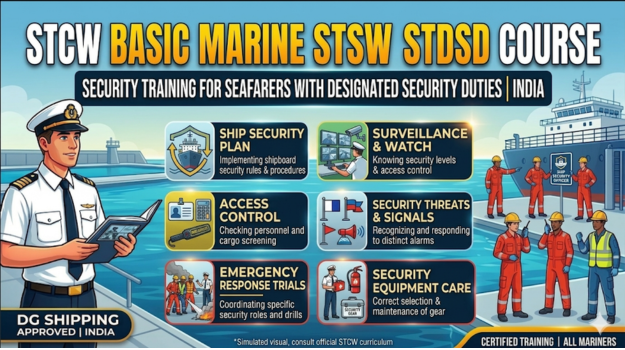
During hours of darkness, a ship’s vulnerability to asymmetric threats increases significantly. Properly maintaining protective deck lighting and securing structural access boundaries to restricted zones such as the navigation bridge, engine room, and steering gear compartment—are essential actions to prevent a quiet infiltration. To ensure you completely understand how to safeguard these high-value areas and maintain reliable lines of contact during a crisis, Nirzara presents the STSDSD Exit Exam Mock - Questions and Answers Set 9. This ninth practice module focuses deeply on restricted area protection protocols, illumination requirements under different MARSEC levels, and secure communication backup configurations.
This specific set on Nirzara contains 30 highly repeated Multiple Choice Questions (MCQs) structured around the latest DG Shipping online portal guidelines. You will face essential STCW questions regarding the identification of spaces that must be permanently locked or monitored, the use of continuous versus randomized lighting patterns to deter waterborne intruders, operational procedures for radio code protocols during an active breach, and emergency signaling interfaces with the Port Facility Security Officer (PFSO). Because a single failure in physical containment can grant intruders control of the vessel, the computer-based exam evaluates these defensive parameters very strictly.
Every MCQ inside Nirzara's Set 9 comes paired with its verified correct answer, offering an instant checkpoint for your revision. The DG Shipping exam frequently tests precise illumination parameters and security communication frequencies to verify your technical accuracy under pressure. Spend a few minutes practicing with these 30 targeted questions today on Nirzara to eliminate confusion, sharpen your exam-taking speed, and comfortably secure your passing marks on the first try!
Practice with 30 questions from the BASIC STSDSD COURSE bank. Each question is verified and explained.
MCQ Practice Questions (30)
Live Mock TestQuestion 1 / 30
Time Left: 15:00
Loading question...
🎉 Mock Test Complete
Your Examination Result
0 / 30
Score Percentage: 0%
Correct
0
Incorrect
0
Skipped
0
1
The ships security assessments must include the following
aThe perceived threat to ship & the consequences of an incidents
bThe port she visits
cThe cargo she carries
dThe nationality of the crew onboard
Correct Answer: Option A
The Ship Security Assessment (SSA), mandated by SOLAS Chapter XI-2 and the ISPS Code, is a comprehensive risk analysis that fundamentally requires identifying potential security threats to the vessel and evaluating the consequences of any security incident. This systematic assessment of perceived threats and their potential impact informs the development of effective security measures and the Ship Security Plan. Therefore, understanding both the nature of threats and the severity of their outcomes is paramount to a compliant and effective security assessment.
2
What is the operation limitation of a security equipment like weld lock;
aThe weld locks can be seen
bThe weld locks can be cut open
cThe weld locks can rust
dThe weld locks look bad
Correct Answer: Option B
While weld locks offer a degree of security, their fundamental operational limitation, as per principles of marine security and engineering, is that they can be compromised by cutting, rendering them ineffective against determined access. This vulnerability necessitates a layered security approach rather than relying solely on weld locks as an absolute deterrent against unauthorized entry. Consequently, Option B accurately identifies a critical limitation inherent in this type of security equipment.
3
STSDSD means:
aSafety training for seafarers for designated safety duties.
bSafety training for seafarers for designated security duties.
cSecurity training for seafarers for designated security duties.
dSecurity training for seafarers for designated safety duties.
Correct Answer: Option C
STSDSD stands for Security Training for Seafarers with Designated Security Duties, as mandated by the International Ship and Port Facility Security (ISPS) Code and further detailed within STCW Code Section A-VI/6. This certification ensures seafarers understand their responsibilities in maintaining ship security and responding to security threats. Proper implementation of STSDSD is crucial for overall maritime security and compliance with international regulations.
4
DOS is required when a ship/port interface could pose significant pollution risk
atrue
bfalse
Correct Answer: Option B
A Declaration of Security (DOS) is a crucial document under the ISPS Code, specifically required for managing and mitigating security risks at the ship/port interface, such as during elevated security levels or specific threats, to ensure shared security responsibilities. Its purpose is entirely focused on maritime security, not environmental protection. Therefore, while pollution risk is a significant concern at the ship/port interface, its management falls under environmental regulations like MARPOL, SOPEP, and operational checklists, not the DOS.
5
Are the crew allowed to give comments on drill;
aYes
bNo
cMay be
dSometimes
Correct Answer: Option A
Absolutely, crew are not only allowed but actively encouraged to provide comments and feedback on drills. This practice is fundamental to a robust safety culture, facilitating continuous improvement in accordance with the ISM Code and ensuring the effectiveness of emergency preparedness as mandated by SOLAS and STCW standards. Such feedback is invaluable for identifying deficiencies, enhancing procedures, and improving overall crew competence and safety onboard.
6
Deficiency means failure to comply with the requirements of the Maritime Security Measures
aTrue
bFalse
Correct Answer: Option A
A deficiency is indeed defined as a failure to comply with the requirements of the International Ship and Port Facility Security (ISPS) Code, which falls under the umbrella of Maritime Security Measures. This aligns with the established definitions used in maritime safety inspections and audits to identify non-conformities that need rectification.
7
For security level 3
ano additional personnel are required
bsame crew as the other security levels to be keep
cAdditional crew to be put on security duty
dRequire to call security personal from ashore
Correct Answer: Option C
For Security Level 3, which indicates a probable or imminent security incident, the ISPS Code mandates the application of all relevant protective security measures. To effectively implement these stringent measures, which include intensified access control, enhanced watch keeping, and specific defensive actions, additional crew members must be assigned to dedicated security duties. This augmentation ensures the necessary vigilance and response capability required to mitigate a severe threat.
8
Which of the below is not included in CSR Record;
aThe SSO Name
bThe details of authority auditing the vessel for DOC & SMC
cThe details of classification society
dThe details of the bareboat charterer
Correct Answer: Option A
The Crew-Sickness Register (CSR) is a document used to record instances of crew illness and injury, focusing on their impact on operational capability and safety, not on the identity of the company's Safety Officer. SOLAS and ISM Code requirements for record-keeping are primarily concerned with the operational and safety management aspects of the vessel, such as auditing details and classification society information, not personal personnel identifiers like the SSO's name. Therefore, the SSO's name is correctly excluded from the CSR.
9
The IMO resolution A 584 (14) of 1985 deals with;
aThe measures to prevent unlawful acts, which threaten safety of life ate sea
bThe measures to prevent unlawful acts, which threaten safety of the ships, and security of the passengers
cThe measures to prevent unlawful acts, which threaten marine environment
dThe measures to prevent unlawful acts, which threaten safety of the ships, its crew and passengers
Correct Answer: Option B
IMO Resolution A.584(14), adopted in 1985, is officially titled "Measures to Prevent Unlawful Acts Which Threaten the Safety of Ships and the Security of Their Passengers and Crews." Option B directly and accurately reflects this core purpose, establishing early international guidelines for maritime security. This resolution was a critical precursor to more comprehensive instruments such as the SUA Convention and the ISPS Code, specifically addressing threats to the physical integrity of vessels and the safety and security of all persons onboard.
10
Each ship shall be verified before the certificate required for the first time
aNo
bYes
Correct Answer: Option B
Before a ship can be issued its certificate for the first time, a thorough verification process is mandated by international regulations like SOLAS to ensure it meets all required safety and operational standards. This initial verification confirms compliance with the relevant conventions and codes, establishing the vessel's seaworthiness and its ability to operate safely. Therefore, the answer is "Yes," as this verification is a prerequisite for certification.
11
The record of DOS shall be maintained for
aLast 8 ports
bLast 9 ports
cLast 10 ports
dLast 11 ports
Correct Answer: Option C
According to the International Safety Management (ISM) Code, which is mandated by SOLAS, the record of the Deliberate Operation of Systems (DOS) shall be maintained for the last 10 ports to ensure a traceable history of system operations for safety and compliance. This 10-port record is crucial for demonstrating due diligence and for any subsequent investigations or audits concerning the vessel's operational integrity and safety.
12
Who shall the Master sent the proposed amendment to the SSP
aThe Flag state
bThe Port state
cThe CSO
dThe Owners
Correct Answer: Option C
The Master shall send any proposed amendments to the Ship Security Plan (SSP) to the Company Security Officer (CSO) for review and approval before submission to the Flag State. The CSO, designated by the company, is responsible for ensuring the SSP's compliance with ISPS Code requirements and for coordinating security matters. This direct line of communication ensures that the company's security oversight is maintained and that proposed changes are properly vetted internally.
13
What can be a possible way smuggling mode on ship
aBy the drinking water
bBy innocent looking people
cBy the bunker
dBy air drop
Correct Answer: Option B
Smuggling frequently involves individuals exploiting their unassuming appearance to conceal illicit goods or facilitate their transport onto a vessel, whether as stowaways, compromised crew, or external agents. This method leverages human interaction and access points, making 'innocent looking people' a significant security vulnerability that vessels must actively monitor as part of their Ship Security Plan under the ISPS Code and general maritime security protocols to prevent illicit trade and uphold safety.
14
What is the duty of armed security guards on board
ato look out and warn in case of sighting pirate
bsleep in the cabin
cgive training to crew in small arms
dwait for crew to inform
Correct Answer: Option A
The primary duty of armed security guards on board is to maintain vigilant lookouts and provide early warning of potential threats, such as pirate activity. This proactive detection and immediate communication are essential for activating the vessel's Ship Security Plan, allowing the crew to implement defensive protocols and take evasive action, thereby enhancing maritime security in accordance with risk mitigation strategies.
15
Security level 3 can be for
aUnlimited period
bSome time
cLimited period
dNone of the above
Correct Answer: Option C
Security Level 3 is declared when a grave and imminent threat is recognized, and it is intended to be temporary to address the specific threat, thus it is for a limited period. This temporary measure is implemented to restore normal operations as soon as the threat has been mitigated. The ISPS Code mandates that security levels are set for the duration required to counter the threat, not indefinitely.
16
Separate embarkation and disembarkation provisions
aOn Passenger vessels
bOn Gas carriers
cOn chemical tankers
dNot provided on any ships
Correct Answer: Option A
Separate embarkation and disembarkation provisions are specifically required on passenger vessels to ensure the safe, efficient, and orderly flow of a large number of persons. This critical design and operational feature minimizes congestion, reduces the risk of accidents, and is a fundamental aspect of maritime safety standards governing passenger ship operations and emergency preparedness, implicitly covered by SOLAS requirements for safe access and egress.
17
Who is required to assit to the master and SSO in case of security incident;
aThe owner
bThe company
cThe flag state
dThe port state
Correct Answer: Option C
The Flag State is the sovereign authority responsible for ensuring its registered vessels comply with international security regulations, such as SOLAS Chapter XI-2 and the ISPS Code. In a security incident, the Flag State is mandated to provide governmental assistance, coordination, and protection to the Master and Ship Security Officer, facilitating broader state-level responses beyond immediate company support. This responsibility underscores its ultimate oversight for the security of its flag vessels and their personnel.
18
Modern definition of piracy included one of the following;
aStealing from the ships stores
bPilferage from the crew cabins
cPickpocketing
dShip wrecking done intentionally to the ship
Correct Answer: Option D
Modern maritime definitions of piracy focus on acts of violence and severe deprivation of liberty committed for private ends aboard a vessel. Option D, intentionally wrecking a ship, fits this definition as it involves severe unlawful acts with malicious intent that compromise the safety and integrity of the vessel, potentially for criminal gain or to inflict damage. Options A, B, and C describe petty theft and pilferage which, while illegal, do not rise to the severity and scope of acts considered piracy under international maritime law.
19
Which of the following equipment are parts of cyber security;
aMeteorological equipment
bPrecision equipment
cDedicated cargo computers
dSOPEP equipment
Correct Answer: Option C
Option C is correct because dedicated cargo computers are part of a vessel's operational technology systems, and protecting these systems from unauthorized access and malicious attacks is a fundamental aspect of maritime cyber security as outlined by regulations and industry best practices. Ensuring the integrity and availability of these systems is crucial for safe cargo operations and overall vessel safety.
20
SSP can be amended without the approval of the administration
aTrue
bFalse
Correct Answer: Option B
The Safety Study Program (SSP) is a mandatory document under the International Maritime Organization's SOLAS Convention, requiring specific approval from the Flag Administration to ensure its compliance with international safety standards. Therefore, the statement that the SSP can be amended without the Administration's approval is false.
21
The CSR is handed over from one flag state to next when the flag changes
aTrue
bFalse
Correct Answer: Option A
The Continuous Synopsis Record (CSR), mandated by SOLAS Chapter XI-1, Regulation 5, is a permanent, sequential record of a ship's history designed to remain with the vessel throughout its operational life. When a ship changes flag, the previous flag State issues a new CSR document (Document of Amendment) to reflect this change and ensure the continuous numbering sequence. This complete set of CSR documents is then transferred with the ship to the new flag State, ensuring an unbroken chronological record of the ship's identity and operational particulars.
22
If the ship is on higher security level than the port:
aThe ship will lower its security level
bThe ship will maintain its security level and sign the DOS
cThe ship will call CSO and ask what to do
dThe ship will call flag and ask what to do
Correct Answer: Option B
Under the ISPS Code, a ship must never operate at a security level lower than that of the port facility. Therefore, if the ship is already at a higher security level, it is imperative to maintain that heightened posture to ensure adequate protection. Concurrently, a Declaration of Security (DOS) must be signed between the ship and port facility to establish agreed security measures for their interface, aligning all parties with the higher standard.
23
Can the port be at lower security level than the ship;
aYes
bNo
cNever
dSometimes yes
Correct Answer: Option A
Yes, the port can indeed be at a lower security level than the ship. This is permissible because security levels for ships and port facilities are determined independently by their respective Contracting Governments or Designated Authorities, based on specific threat intelligence and risk assessments. While coordination is required, a ship's security level might be elevated due to its flag state's assessment or specific intelligence related to the vessel, even if the port facility it is calling maintains a lower security level.
24
During bomb search, which of the following is an important principle to follow;
aTry to reach behind bulkhead to find a bomb
bKnow exactly what a bomb looks like
cDo not touch any suspicious pacakage
dThrow any suspicious items overboard
Correct Answer: Option C
Option C is the fundamental safety principle because any direct interaction with a suspicious package or potential improvised explosive device carries an extreme risk of accidental detonation, endangering the vessel and crew. Maritime safety protocols, reinforced by the ISPS Code and general emergency procedures, strictly prohibit untrained personnel from touching or disturbing a suspected device. Instead, the immediate area must be isolated, and the discovery reported to the Master and relevant authorities for expert intervention.
25
The ship be at lower security level than the port;
aYes
bNo
cAlways
dSome Times
Correct Answer: Option B
The ship's security level must always be equal to or higher than the port facility's security level to ensure consistent and adequate protection. SOLAS Chapter XI-2 and the ISPS Code mandate that a ship's security level dictates the security measures to be implemented, and these must at least match those required by the port. Therefore, a ship cannot operate at a lower security level than the port it is entering or interacting with.
26
ISPS code do not apply to :
aWarships
bCoast Guard ships
cCargo ships of 500 GRT
dMODU
Correct Answer: Option B
The International Ship and Port Facility Security (ISPS) Code, mandated under SOLAS Chapter XI-2, specifically exempts warships and naval auxiliaries from its requirements due to their unique operational nature and existing security protocols. Coast Guard vessels, often considered military or government service ships, fall under this exemption, while cargo ships over 500 GRT and Mobile Offshore Drilling Units (MODUs) are generally covered by the Code.
27
Ship and port interface means;
aThe interaction where ship indirectly effected by
action of port services to or from ship.
bThe interaction where ship directly effected by
action of port services to or from ship
cThe interaction where ship is not effected by
action of port services to or from ship
dThe interaction where port directly and
immediately effected by action of post services to
or from ship
Correct Answer: Option B
The ship and port interface precisely defines the direct interaction where a vessel is immediately and operationally affected by actions of port services such as pilotage, tug assistance, mooring, and cargo handling. These services directly influence the ship's maneuvering, safety, stability, and operational status upon arrival, during stay, and departure. This direct engagement is fundamental to maritime safety, efficiency, and adherence to established ship-shore interface protocols.
28
Most venerable place in toilets and showers where we can find hidden drugs and contrabands;
aIn the heater
bIn shower closet
cIn the washbasin cabinet
dOn the soap stand
Correct Answer: Option A
The heater compartment in shipboard toilets and showers is a common hiding place for contraband due to its enclosed nature and less frequent inspection compared to other areas. SOLAS and STCW regulations emphasize the importance of maintaining ship security, and this location presents a potential risk that must be considered. Thorough searches of such discreet areas are crucial for ensuring the safety and security of the vessel and its crew.
29
At security level 3 the following lights to be switched on
aAll lights showing clearly the deck and surround the vessel
bFord light so that officer on the bridge sees some climbing through anchor chain
cAll cabin lights
dAll sore light
Correct Answer: Option A
At Security Level 3, vessel owners and operators are mandated to illuminate all exterior lighting, including deck and surrounding areas, to enhance visibility and deter potential threats. This comprehensive illumination is a critical security measure to make unauthorized access more difficult and to improve the ability of the crew to observe any suspicious activity. Adherence to this standard ensures compliance with international maritime security regulations designed to maintain the safety and integrity of the vessel.
30
When in port who does the declaration of security
aSSO & CSO
bSSO & the local coast guard officer
cSSO & the PFSO
dSSO & local agent
Correct Answer: Option C
The Declaration of Security (DoS) is a formal agreement required by SOLAS Chapter XI-2 and the ISPS Code, detailing the security measures to be shared between a ship and a port facility. This critical document must always be completed and signed jointly by the Ship Security Officer (SSO), representing the vessel, and the Port Facility Security Officer (PFSO), representing the port facility, to ensure coordinated and effective security during their interface.
About Me
NIRZARA TEAM
Author & Contributor
The Nirzara Team is a group of dedicated marine professionals and educators committed to improving maritime learning through digital education. Our team works to provide quality study materials, practical knowledge, and career guidance to support seafarers and marine students worldwide.