STSDSD Exit Exam Mock - Questions and Answers Set 6
By NIRZARA TEAM
Published: May 03, 2026 at 7:40 pm
Share:
MARINE EXAM
15 min read
STSDSD Exit Exam Mock - Questions and Answers Set 6
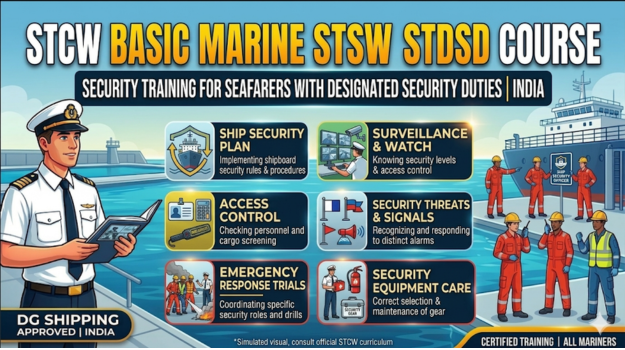
As commercial vessels become increasingly digitized and integrated with shore-based networks, maritime security has expanded far beyond physical boundaries. Today, a digital breach of a ship's navigation or ballast control systems poses just as much danger as a physical intruder. Furthermore, coordinating security responsibilities between a ship and a port facility requires formal legal alignments before cargo operations can begin. To help you master these modern operational challenges, Nirzara introduces the STSDSD Exit Exam Mock - Questions and Answers Set 6. This sixth practice module focuses heavily on the Declaration of Security (DoS), shipboard cyber security protocols, and internal security assessments.
This targeted set on Nirzara contains 30 high-frequency Multiple Choice Questions (MCQs) mapped precisely to the latest DG Shipping online exam trends. You will encounter critical STCW questions regarding when a Declaration of Security must be completed, identifying phishing and malware risks on shipboard networks, maintaining the integrity of satellite communication systems, and conducting routine security log verifications. Since a loophole in either digital networks or port-ship coordination can compromise the vessel's safety, the computer-based test evaluates these precise operational parameters very strictly.
Every question inside Nirzara's Set 6 features its direct, verified correct answer, providing a clean and rapid checkpoint for your final preparation. The DG Shipping exit portal frequently relies on modern digital and legal scenarios to check your situational awareness. Spend a few minutes solving these 30 targeted questions today on Nirzara to eliminate exam anxiety, sharpen your answering speed, and comfortably secure your passing marks on the very first try!
Practice with 30 questions from the BASIC STSDSD COURSE bank. Each question is verified and explained.
MCQ Practice Questions (30)
Live Mock TestQuestion 1 / 30
Time Left: 15:00
Loading question...
🎉 Mock Test Complete
Your Examination Result
0 / 30
Score Percentage: 0%
Correct
0
Incorrect
0
Skipped
0
1
What is not included in SSI(likely expansion Ship Security Inspection
aSecurity program
bTechnical details of the screening equipment
cShips cargo plan
dLocation of SSAS
Correct Answer: Option C
The Ship's Cargo Plan primarily details cargo stowage for ship stability, trim, and operational efficiency, falling under operational and navigational management, not directly within the scope of a Ship Security Inspection (SSI). An SSI, as mandated by SOLAS Chapter XI-2 and the ISPS Code, focuses on security vulnerabilities, access control, security equipment functionality (like SSAS or screening equipment), and the implementation of security procedures. While security personnel verify cargo integrity against manifests, the technical specifics of the stowage plan itself are not a direct component of a security assessment.
2
What is DOC
aDeclaration of safety
bDeclaration of cargo
cDeclaration of security
dDeclaration of class
Correct Answer: Option B
The correct answer, Declaration of Cargo, refers to the official document providing comprehensive details on the type, quantity, and nature of all cargo carried aboard a vessel. This declaration is critically important for ensuring compliance with SOLAS regulations, particularly concerning safe stowage, accurate stability calculations, and effective emergency response planning for dangerous goods. It serves as an essential record for port authorities, customs, and terminal operators, directly contributing to overall maritime safety and regulatory adherence.
3
What is the below is not included in CSR record
aThe Master Name
bThe details of the authority auditing the vessel for DOC and SMC
cThe details of classification society
dThe details of the bareboat charterer
Correct Answer: Option A
The Continuous Synopsis Record (CSR) is designed by SOLAS Chapter XI-1, Regulation 5, to provide a ship's continuous administrative history, focusing on stable details such as ownership, flag state, ISM Company, and classification/auditing authorities. The Master's name is not included because this personnel information changes frequently and does not represent a static element of the ship's fundamental identity or regulatory compliance history. Details regarding classification societies, auditing authorities for ISM/ISPS, and bareboat charterers are integral to the ship's operational and regulatory identity, making their inclusion necessary.
4
What is special equipment provided for transmitting a security alert to competent authority on sgore?
aShip Security Alert System
bShips safety alert system
cShip general alert system
dShip special alert system
Correct Answer: Option A
The Ship Security Alert System (SSAS) is specifically mandated by SOLAS Chapter XI-2, Regulation 6, to transmit a security alert to a competent authority on shore when activated by the ship's master or designated person. This system is designed to be discreet and separate from other alarm systems, ensuring a secure and confidential communication of a security threat. Therefore, Option A is the correct and officially recognized equipment for this purpose.
5
Security level relates to the degree of the threat;
aTrue
bFalse
Correct Answer: Option A
This statement is unequivocally true. The International Ship and Port Facility Security (ISPS) Code, adopted under SOLAS Chapter XI-2, establishes a three-tiered system of security levels (Level 1, 2, and 3) that are directly proportional to the assessed degree of a security threat. A higher security level is declared when the threat of a security incident is deemed greater or more imminent, requiring correspondingly more stringent protective measures.
6
Drills are more supervised activities that are used to test a single measure or procedure in the SSP;
aTrue
bFalse
Correct Answer: Option A
Option A is correct because drills, as a fundamental component of maritime security and safety management systems under SOLAS and the ISPS Code, are precisely defined as highly supervised activities designed to test proficiency in a single specific procedure, equipment operation, or response measure within the Ship Security Plan. This focused approach ensures individual competency and validates discrete elements of the overall security framework, differentiating them from more comprehensive exercises.
7
The most vulnerable activation switch shall be so designed to prevent inadvertent activation of alert
aTrue
bFalse
Correct Answer: Option A
True. Under SOLAS and general maritime safety principles, critical activation switches, especially those deemed 'vulnerable,' must incorporate design features to prevent inadvertent activation. This is essential to avoid false alarms, which can erode crew confidence, create confusion, and misdirect vital resources, thereby ensuring the reliability and effectiveness of genuine alerts. Such design considerations, including protected buttons or multi-step activation, are crucial for maintaining operational integrity and safety at sea.
8
The SSP goves details of the procedures to be followed in handling cargo and baggage;
aTrue
bFalse
Correct Answer: Option A
The Ship Security Plan (SSP) mandated by the International Ship and Port Facility Security (ISPS) Code provides comprehensive guidelines for the security measures to be implemented onboard, including detailed procedures for cargo and baggage handling to prevent unauthorized access or tampering. Therefore, the statement that the SSP gives details of these procedures is indeed true, reflecting its crucial role in maintaining maritime security.
9
What is security sensitive information;
aThe information that could help someone in defeating the safety systems
bThe information that could help someone in defeating the Security System
cThe information that could help someone in defeating the loading system
dThe information that could help someone in defeating the discharging system
Correct Answer: Option B
Security sensitive information, as defined by international maritime security standards including SOLAS Chapter XI-2, refers to any data that, if compromised, could aid an individual or group in breaching or circumventing a vessel's security plan and its associated measures. This directly relates to enabling unauthorized access or harmful actions against the ship's security infrastructure. Therefore, Option B is correct because it specifically addresses information that could compromise the vessel's security system.
10
To ensure shipboard personnel are ready to deal with different security situations what should you carry out
aMeetings
bDiscussions
cNotices
dDrill and exercises
Correct Answer: Option D
Shipboard personnel must be prepared for security situations through practical application; therefore, regular drills and exercises are mandated by SOLAS Chapter XI-2 and the ISPS Code to test and reinforce security plans and procedures. These exercises ensure that crew members can effectively respond to various security threats, rather than relying solely on passive communication methods like meetings, discussions, or notices. This active training approach aligns with maritime safety standards by building competence and immediate reaction capabilities.
11
Which shipboard personnel should be able to recognize and detect weapons, dangerous substances and devices.
aSSO
bMaster
cDuty officer
dAll shipboard Personnel
Correct Answer: Option D
Maritime security, as outlined in the ISPS Code and reinforced by fundamental maritime safety principles, mandates that recognizing and detecting weapons, dangerous substances, and devices is a collective responsibility. While the Ship Security Officer (SSO) leads security implementation, every shipboard personnel member must possess the awareness and training to identify potential threats, as they could be the first to encounter them. This universal vigilance is crucial for the overall safety and security of the vessel and its crew.
12
Should ensure that the flag state is consulted at an early stage in their consideration of the decision to place PACSP Board to ensure that any statutory requirements are met
aShip master
bCSO
cSSO
dShip owner
Correct Answer: Option B
The Company Security Officer (CSO) is explicitly responsible under the International Ship and Port Facility Security (ISPS) Code for ensuring the effective implementation and maintenance of the Ship Security Plan. This critical role involves direct liaison with the Flag State Administration on all security matters, including seeking approval for security-related arrangements or consulting on any significant decisions that impact the ship's statutory security requirements, such as establishing a 'PACSP Board'. Therefore, the CSO is the designated individual to ensure early consultation with the flag state to guarantee full compliance.
13
The PFSP and emergency response plans should be based on a:
aRisk Assessment
bGroup discussions
cLoss prevention
dMemorandum
Correct Answer: Option A
The Port Facility Security Plan (PFSP) and all emergency response plans are fundamentally built upon a thorough Risk Assessment. This systematic process, mandated by international maritime conventions such as SOLAS (including the ISM and ISPS Codes), identifies specific threats, vulnerabilities, and potential consequences. By understanding these inherent risks, effective and tailored strategies can be developed to prevent incidents and ensure robust emergency preparedness, aligning with critical maritime safety and security standards.
14
Which information to be included in your search plan;
aAreas to be searched
bPersonal to be involved in search
cRestricted areas
dAll the above
Correct Answer: Option D
A comprehensive search plan, vital for effective search and rescue operations and adherence to maritime safety protocols, must meticulously detail the 'areas to be searched' to ensure systematic coverage. Furthermore, it is essential to clearly identify the 'personnel to be involved in search' with their assigned roles and resources for efficient coordination. Equally important is the precise delineation of 'restricted areas' to maintain the safety of the search party and prevent inadvertent entry into hazardous or prohibited zones. Therefore, a complete and compliant search plan necessarily encompasses all these critical elements.
15
Which of the below is not included in CSR record
aThe CSO Name
bThe details of the authority auditing the vessel for DOC & SMC
cThe details of classification society
dThe details of the bareboat charterer
Correct Answer: Option A
The Continuous Synopsis Record (CSR) is a mandatory document detailing a ship's history and ownership, and while it lists the Company Security Officer and Company Ship Security Officer, the specific "CSO Name" referring to the overall Company Security Officer for the vessel is not a required entry. The CSR does, however, require the details of the auditing authority for DOC and SMC, the classification society, and the bareboat charterer, as these are integral to the ship's regulatory compliance and operational status.
16
At security level the measures include increased frequency of screening, more robust monitoring of access and movement control measures
aLevel 1
bLevel 2
cLevel 3
dLevel 4
Correct Answer: Option C
According to the International Ship and Port Facility Security (ISPS) Code, Security Level 3 is declared when there is a probable or imminent risk of a security incident, necessitating the implementation of maximum protective measures. At this exceptional level, port facilities and ships must enact extensive and comprehensive security protocols, including significantly increased frequency of screening all persons and cargo, along with the most robust and stringent monitoring of all access points and movements, often suspending routine operations. These extreme measures are beyond the heightened vigilance of Level 2 and are specific to an immediate threat situation.
17
What can be a possible way smuggling mode on ship
aBy the drinking water
bBy innocent looking people
cBy the bunker
dBy air drop
Correct Answer: Option B
Smuggling frequently involves individuals exploiting their unassuming appearance to conceal illicit goods or facilitate their transport onto a vessel, whether as stowaways, compromised crew, or external agents. This method leverages human interaction and access points, making 'innocent looking people' a significant security vulnerability that vessels must actively monitor as part of their Ship Security Plan under the ISPS Code and general maritime security protocols to prevent illicit trade and uphold safety.
18
Which of the following is not protected by the ships security plan;
aThe personal on board
bThe cargo
cThe ships store
dThe port facility
Correct Answer: Option D
The Ship Security Plan (SSP), required under SOLAS Chapter XI-2 and the ISPS Code, is exclusively focused on protecting the ship, its personnel, cargo, and stores from security incidents. While the SSP dictates how the ship interfaces securely with a port, the port facility itself is protected by its own distinct Port Facility Security Plan (PFSP), as mandated by the ISPS Code. Therefore, the ship's security plan does not directly cover the security of the port facility.
19
Coastal states/Port States should report to IMO any act of armed robbery in their waters or acts of piracy close to their waters which have been reported;
aTrue
bFalse
Correct Answer: Option A
Coastal and Port States are indeed required to report acts of piracy and armed robbery to the International Maritime Organization (IMO). This comprehensive reporting allows the IMO to maintain a global database, analyze patterns, and consequently formulate effective resolutions and guidelines for enhancing maritime security and safety worldwide. Such data-driven approaches are fundamental to fulfilling the IMO's mandate for safe and secure international shipping, aligning with the principles of maritime security frameworks.
20
Which of the following element shall be part of the security drill on ship?
aAttacks from seaward while the superintendent is at berth
bAttacks from seaward while ship is at berth
cAttacks from seaward while agent is at berth
dAttacks from seaward while berth is vacant
Correct Answer: Option B
Ship security drills, as mandated by the International Ship and Port Facility Security (ISPS) Code, require realistic scenarios to test a vessel's security plan and crew response capabilities. An "attack from seaward while the ship is at berth" represents a crucial and highly plausible ship-port interface security scenario, encompassing potential threats like piracy, terrorism, or sabotage to the vessel, its personnel, and the port facility. Practicing this specific situation ensures the crew is proficient in implementing protective measures during a common and potentially vulnerable period.
21
CSR will have details of following
aName and details of owner
bISM Company details
cBareboat Charter details
dAll the above
Correct Answer: Option D
The Continuous Synopsis Record (CSR) is a mandatory on-board document under SOLAS Chapter XI-1, Regulation 5, designed to provide a comprehensive and continuous history of the ship. It meticulously records crucial administrative and operational data, including the registered name and details of the shipowner, the ISM Company responsible for managing the ship, and any bareboat charter details if applicable. Therefore, all the listed options—owner details, ISM Company details, and bareboat charter details—are essential components of the ship's CSR, making Option D correct.
22
When a visitor onboard required to present an ID
aOnly at security level 3
bAt security level 2 & 3
cAt security level 1, 2 & 3
dNever
Correct Answer: Option C
Maritime regulations, including SOLAS Chapter XI-2 and the ISPS Code, mandate that all visitors present valid identification at all security levels, specifically levels 1, 2, and 3, to maintain vessel security and control access. This practice is a fundamental component of the vessel's security plan, ensuring unauthorized individuals do not gain entry. Adherence to this protocol is crucial for comprehensive maritime safety and security protocols.
23
Crowd management and control techniques have the following parts
aLife saving appliance and control plans
bAssisting passengers en route to assembly and embarkation stations
cMustering procedures
dAll of the above
Correct Answer: Option D
According to SOLAS and STCW regulations, effective crowd management encompasses all listed aspects: life-saving appliance and control plans are crucial for organized evacuation, assisting passengers en route to assembly and embarkation stations ensures their safe and orderly progress, and mustering procedures provide the framework for accounting for everyone. Therefore, "All of the above" correctly identifies the comprehensive nature of crowd management and control techniques required for maritime safety.
24
What is the latest ILO convention on SID (Seafarers Identity Document)
aC 180
bC 108
cC 185
dC 208
Correct Answer: Option C
The correct answer is C 185, referring to the Seafarers' Identity Documents Convention, 2003. This ILO convention is the most recent and authoritative international standard designed to enhance maritime security and facilitate the legitimate movement and shore leave of seafarers. Its implementation is crucial for ensuring compliance with international security frameworks and supporting seafarer welfare, which are integral aspects of overall maritime safety and operational efficiency.
25
Which of the following may be available in the safe house or citadel:
aFresh linen
bCCTV display for boarding point, upper deck and bridge
cFridge for provision
dTV for recreation
Correct Answer: Option B
The safe house or citadel is a hardened area designed for crew protection during security threats, and its primary function necessitates the ability to monitor external conditions. Consequently, a CCTV display providing critical views of boarding points, upper deck, and the bridge is an essential security feature, enabling the crew to maintain situational awareness and relay vital intelligence while secure. This capability directly supports maritime security protocols and the effective use of a citadel as a defensive measure.
26
What is a continuous synopsis record
aA plan including all security measures on board
bA record of vessel history
cA record of all security incidents
dA plan for continuous maintenance and security equipment
Correct Answer: Option B
The Continuous Synopsis Record (CSR), mandated by SOLAS Regulation XI-1/5, serves as a vital on-board document that provides a comprehensive historical record of the vessel. It meticulously tracks key administrative information such as the ship's name, flag, owner, registered owner, classification society, and the company responsible for its ISM Code compliance, along with any changes to these details. Therefore, it is definitively a record of the vessel's history, ensuring transparency and traceability throughout its operational life.
27
As per ISPS code it is compulsory for the company security officer to visits company ship at every port.
aYes
bNo
cSome times yes
dSome times no
Correct Answer: Option B
The ISPS Code does not mandate that the Company Security Officer (CSO) physically visits every company ship at every port. While the CSO is responsible for ensuring the development, implementation, and periodic review of ship security plans, this critical oversight can be achieved through various methods, and the Code does not specify a requirement for such frequent physical presence. The CSO's role focuses on the overall effectiveness and compliance of the company's security program, not continuous shipboard presence in every port call.
28
In the event of pirates firing small arms/RPG what are your actions;
aFight back with all on board
bFire pyro techniques at pirates
cSound SSAS & DSC alert and muster the crew
dSwitch off AIS
Correct Answer: Option C
Option C is correct as it mandates immediate activation of the Ship Security Alert System (SSAS) and Digital Selective Calling (DSC) distress alert to notify authorities and the wider maritime community of the imminent threat, a critical step under SOLAS regulations for requesting assistance. Simultaneously, mustering the crew is paramount for their safety, accountability, and preparation for protective measures, such as retreating to a citadel, aligning with essential maritime emergency and security procedures outlined in SOLAS and STCW. These actions prioritize life preservation and prompt external assistance over direct confrontation or non-standard responses.
29
The SSAS does not raise any alarm on-baord;
aFalse
bTrue
Correct Answer: Option B
The statement is true; the Ship Security Alert System (SSAS), as mandated by SOLAS Chapter XI-2/6, is specifically designed for silent operation. Its primary function is to discreetly transmit a security alert to competent authorities ashore without raising any audible or visual alarm on board. This silent activation is crucial to prevent alerting perpetrators and to ensure the safety of the crew during a security incident.
30
Ship’s stores to be checked prevent ship’s stores from being accepted without inspection
ayes
bno
cOnly when Master orders
dOnly when CSO orders
Correct Answer: Option B
All ship's stores must be thoroughly inspected upon receipt to verify quantity, quality, and compliance with safety and security standards, as required by good seamanship and the ISM Code. While this procedure is mandatory and explicitly designed to ensure proper inspection, the mere existence of the requirement does not absolutely *prevent* the possibility of human error or negligence leading to stores being accepted without inspection. Therefore, the statement that the requirement 'prevents' such an occurrence is factually incorrect.
About Me
NIRZARA TEAM
Author & Contributor
The Nirzara Team is a group of dedicated marine professionals and educators committed to improving maritime learning through digital education. Our team works to provide quality study materials, practical knowledge, and career guidance to support seafarers and marine students worldwide.