STSDSD Exit Exam Mock - Questions and Answers Set 5
By NIRZARA TEAM
Published: Apr 29, 2026 at 4:50 am
Share:
MARINE EXAM
15 min read
STSDSD Exit Exam Mock - Questions and Answers Set 5
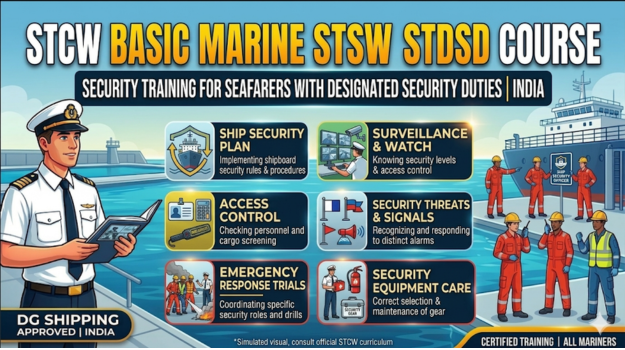
A robust maritime security framework is only as effective as the crew's ability to execute emergency protocols under intense psychological pressure. When a ship faces a dynamic security crisis—such as a localized bomb threat, an unexpected hostage situation, or a breach of restricted zones—chaos can easily compromise safety lines. To ensure you completely understand how to implement emergency contingency plans seamlessly, Nirzara presents the STSDSD Exit Exam Mock - Questions and Answers Set 5. This fifth practice module focuses deeply on security drill execution, managing panic, bomb search techniques, and structural emergency communication patterns.
This specific set on Nirzara contains 30 highly repeated Multiple Choice Questions (MCQs) structured around the latest DG Shipping online portal guidelines. You will face essential STCW questions regarding the regulatory frequency of shipboard security drills under the ISPS Code, the correct physical search methodology for a suspected explosive device, handling crowd control inside accommodation areas, and coordinating with port facility security personnel. Because a single misstep in reporting a threat can escalate a vulnerability into an active emergency, the computer-based exam evaluates these crisis response steps very strictly.
Every MCQ inside Nirzara's Set 5 comes paired with its verified correct answer, offering an instant checkpoint for your revision. The DG Shipping exam frequently tests precise emergency reporting templates and threat level responses to verify your operational accuracy. Spend a few minutes practicing with these 30 targeted questions today on Nirzara to eliminate confusion, sharpen your exam-taking speed, and comfortably secure your passing marks on the first try!
Practice with 30 questions from the BASIC STSDSD COURSE bank. Each question is verified and explained.
MCQ Practice Questions (30)
Live Mock TestQuestion 1 / 30
Time Left: 15:00
Loading question...
🎉 Mock Test Complete
Your Examination Result
0 / 30
Score Percentage: 0%
Correct
0
Incorrect
0
Skipped
0
1
What is the operation limitation of a security equipment like light bulb
aThe bulb can be big
bThe bulb can be small
cThe bulb can fuse or break
dNone of the above
Correct Answer: Option C
A security light bulb's operational limitation is its susceptibility to fusing or breaking, which can compromise the intended security function and is a critical consideration in maintaining vessel safety and security protocols mandated by international regulations. Failure of such equipment necessitates immediate attention to prevent security breaches or navigational hazards.
2
The port facility may include following
aAnchorage
bWaiting berth
cApproaches
dAll the above
Correct Answer: Option D
A port facility, as defined by international maritime safety standards and implied by SOLAS and ISPS Code, encompasses all areas designated for safe vessel navigation, mooring, and cargo operations, including approach channels, anchorage areas for vessels awaiting berths, and the waiting berths themselves. Therefore, an inclusive understanding of a port facility as per maritime conventions and operational requirements recognizes anchorage, waiting berths, and approaches as integral components.
3
Which of the following is not protected by the ships security plan;
aThe personal on board
bThe cargo
cThe ships store
dThe port facility
Correct Answer: Option D
The Ship Security Plan (SSP), required under SOLAS Chapter XI-2 and the ISPS Code, is exclusively focused on protecting the ship, its personnel, cargo, and stores from security incidents. While the SSP dictates how the ship interfaces securely with a port, the port facility itself is protected by its own distinct Port Facility Security Plan (PFSP), as mandated by the ISPS Code. Therefore, the ship's security plan does not directly cover the security of the port facility.
4
"Under ISPS code describes the current scenario related to the security threat to the country and its coastal region including the ships visiting that country"
aExchange rate
bGDP
cDaily news channels
dSecurity levels
Correct Answer: Option D
Under the ISPS Code, "Security levels" (Level 1, 2, or 3) are the precise and formal mechanism designated by Contracting Governments to describe the current security threat scenario for a country, its coastal region, and all ships and port facilities within its jurisdiction. These levels directly communicate the degree of risk of a security incident and mandate specific, corresponding security measures to be implemented by ships and port facilities. This standardized system ensures an appropriate and coordinated response to evolving maritime security threats.
5
Various types of exercises with CSO, PFSO, relevant authorities of CG and SSO should be carried out at least once in
a6 months
b12 to 18 months
c18 months
d12 months
Correct Answer: Option B
According to the International Ship and Port Facility Security (ISPS) Code, specifically Part A, Section 13.6, joint security exercises involving the Ship Security Officer (SSO), Company Security Officer (CSO), Port Facility Security Officer (PFSO), and relevant authorities such as the Coast Guard, must be conducted at least once every 12 to 18 months. This mandated interval ensures the comprehensive testing and readiness of both the Ship Security Plan and the Port Facility Security Plan through coordinated practical application. Adherence to this specific timeframe is crucial for maintaining robust maritime security and effective incident response capabilities.
6
Which of the following record shall we keep on-board for last 10 ports
aPort agent details
bDeclaration of security details
cPort captains’ details
dHarbour masters details
Correct Answer: Option B
The Declaration of Security (DoS) is a mandatory record under the International Ship and Port Facility Security (ISPS) Code, specifically SOLAS Chapter XI-2, outlining shared security responsibilities between the ship and a port facility. Ships are strictly required to keep all Declarations of Security on board for a minimum period of 12 months, thereby encompassing records for the last 10 ports of call, for verification of compliance with international maritime security standards.
7
SSP should address all security threats of a ship when not in service
aTrue
bFalse
Correct Answer: Option B
The Ship Security Plan (SSP), mandated by SOLAS Chapter XI-2 and the ISPS Code, is specifically designed to address security threats and measures for a ship *while it is in service* and engaged in its normal operational activities, including port interfaces and voyages. When a ship is "not in service" (e.g., laid up for an extended period or decommissioned), its security arrangements typically fall under different provisions, often managed by the facility where it is located or specific non-operational security plans, as the operational SSP is not tailored for these distinct circumstances.
8
Where do we find documentary evidence of masters overriding authority?
aIn masters contract
bIn masters standing over notes
cIn SSP
dIn companies’ website
Correct Answer: Option C
The documentary evidence of the Master's overriding authority, particularly regarding security matters, is explicitly found in the Ship Security Plan (SSP). This is mandated by the International Ship and Port Facility Security (ISPS) Code, a component of SOLAS Chapter XI-2, which requires clear definition of the Master's ultimate decision-making power for the safety and security of the vessel, crew, and cargo in all circumstances, including overriding company instructions if necessary. This provision ensures immediate and decisive action can be taken in the face of security threats.
9
If pirates board the ship, you will;
aShout and scream
bFight with them
cTry to jump overboard
dBe calm and cooperate
Correct Answer: Option D
Option D, 'Be calm and cooperate,' is the correct action because the paramount priority during a pirate boarding is the safety of life. Resistance or confrontational actions will invariably escalate the situation, provoking violence and increasing the risk of harm to crew members. This principle of de-escalation and prioritizing human life aligns with international maritime safety standards, including those supported by SOLAS and STCW, which advocate for actions that minimize danger in emergency situations.
10
Does master has power to override ship security plan if required without consulting CSO;
aNo
bNever
cYes
dMay be
Correct Answer: Option C
The Master, by virtue of their ultimate authority and overriding command, holds the sole responsibility for the safety and security of the ship, its crew, and the marine environment. SOLAS Chapter XI-2, Regulation 8 explicitly grants the Master the power to depart from the provisions of the approved Ship Security Plan (SSP) if, in their professional judgment, it is necessary to respond to an immediate threat. While the Company Security Officer (CSO) must be informed as soon as practicable, this communication is typically after the immediate decision and action has been taken due to the exigency of the situation, thus allowing the Master to act without prior consultation in an emergency.
11
Why is it advised to hide in the safe house of citadel
aTo avoid being caught by the pirates and hence they take control of the ship
bTo take some rest before pirates take over
cTo avoid working after the pirates take over
dTo protest against the pirates attack
Correct Answer: Option A
Retreating to the ship's citadel during a piracy attack is a critical maritime security protocol specifically designed to deny pirates access to the crew. By securing the crew within this fortified space, the attackers are prevented from taking control of the vessel's navigation, propulsion, or communication systems, thereby maintaining the ship's integrity and preventing its diversion. This strategy is a fundamental aspect of crew safety and vessel protection under international maritime security standards and best practices.
12
Which of these indicators that an individual may be a drug smuggler
aThe individual spends his or her free time laying out with others
bThe individual wears bulky or out of season clothing
cThe individual makes small local purchases
dIndividual is disinterested in the ships cargo
Correct Answer: Option D
Disinterest in the ship's legitimate cargo is a key indicator of potential illicit activity, as individuals involved in smuggling prioritize the concealment and transport of their contraband over the vessel's declared manifest or normal operations. Such a lack of engagement suggests their presence on board serves an ulterior, unlawful purpose, deviating from expected behavior of legitimate crew or passengers. This behavioral anomaly aligns with indicators maritime security protocols, informed by SOLAS and the ISPS Code, train personnel to identify for preventing illicit cargo and personnel movement.
13
Who is responsible for the implementation of the ship security plan on-board;
aThe safety officer
bThe Ship Security Officer
cThe duty officer
dThe chief engineer
Correct Answer: Option B
The Ship Security Officer (SSO) is directly and unequivocally designated by the Company and the Master as the individual responsible for the implementation and oversight of the ship security plan on board. This role is established under the International Ship and Port Facility Security (ISPS) Code, part of SOLAS, and mandates the SSO to coordinate all security matters. Their duties include ensuring security measures are maintained, reporting security incidents, and conducting regular security drills as per the ship security plan.
14
IMO acted with rapidity to enhance maritime security following;
a09/11 Incident
b10/11 Incident
c09/12 Incident
d10/11 incident
Correct Answer: Option A
The 09/11 terrorist attacks profoundly exposed critical vulnerabilities in global security, directly prompting the International Maritime Organization to act with unprecedented urgency. In swift response, the IMO adopted comprehensive amendments to SOLAS Chapter XI-2 and the mandatory International Ship and Port Facility Security (ISPS) Code, establishing a robust framework for maritime security for ships and port facilities worldwide. This rapid implementation directly addressed the heightened threat landscape that emerged after the incident.
15
Port facility includes location where the ship/port interface takes place;
aTrue
bFalse
Correct Answer: Option A
The statement is unequivocally true. As explicitly defined within the International Ship and Port Facility Security (ISPS) Code, which is integral to SOLAS Chapter XI-2 on Maritime Security, a "port facility" specifically denotes the location where the ship/port interface takes place. This interface is where essential operations such as cargo handling, passenger embarkation/disembarkation, bunkering, and security protocols between the vessel and the land facility occur.
16
What is the operation limitation of a security equipment like Radio:
aRadio can be loud.
bRadio can be low.
cRadio signal can be jammed.
dNone of the above.
Correct Answer: Option C
Radio signals are essential for maritime safety and security, as mandated by SOLAS Chapter IV and GMDSS regulations. The most critical operational limitation for security equipment like a radio is the potential for signal jamming, which intentionally or unintentionally interferes with or blocks vital communication channels. This disruption directly compromises a vessel's ability to transmit distress alerts, receive navigation warnings, and maintain secure communication, thereby severely impacting maritime safety and security operations.
17
Who shall be involved in the ship shore security drill
aShip security officers
bCompany security officers
cContracting government
dAll the above
Correct Answer: Option D
A ship-shore security drill, mandated by the International Ship and Port Facility Security (ISPS) Code, requires the active involvement of the Ship Security Officer (SSO) for onboard execution and the Company Security Officer (CSO) for oversight and compliance with the Ship Security Plan. Additionally, the Contracting Government, through its Designated Authority and Port Facility Security Officer (PFSO), represents the critical shore-side element, ensuring the Port Facility Security Plan is effectively integrated and tested against the ship's procedures. Consequently, thorough testing of the ship/port interface and adherence to international maritime security standards necessitate the participation of all these roles.
18
What is the below is not included in CSR record
aThe Master Name
bThe details of the authority auditing the vessel for DOC and SMC
cThe details of classification society
dThe details of the bareboat charterer
Correct Answer: Option A
The Continuous Synopsis Record (CSR) is designed by SOLAS Chapter XI-1, Regulation 5, to provide a ship's continuous administrative history, focusing on stable details such as ownership, flag state, ISM Company, and classification/auditing authorities. The Master's name is not included because this personnel information changes frequently and does not represent a static element of the ship's fundamental identity or regulatory compliance history. Details regarding classification societies, auditing authorities for ISM/ISPS, and bareboat charterers are integral to the ship's operational and regulatory identity, making their inclusion necessary.
19
SSP cannot be amended without the approval of the administration
aTrue
bFalse
Correct Answer: Option A
The Safety Study Program (SSP) is a critical component of a ship's safety management system, detailing procedures for emergency preparedness and response. As such, any amendments to the SSP require formal approval from the Flag Administration to ensure continued compliance with SOLAS and national regulations. Therefore, it is true that the SSP cannot be amended without the administration's approval.
20
Which of the following elements are tested during ship shore security drill
aThese exercises shall check the availability of security resources
bThese exercises shall check the availability of safety resources
cThese exercises shall check the availability of sailing resources
dThese exercises shall check the availability of social resources
Correct Answer: Option A
Ship-shore security drills, as mandated by the ISPS Code under SOLAS Chapter XI-2, are fundamentally conducted to evaluate the effectiveness of the Ship Security Plan and the preparedness of the crew and vessel to respond to security threats. A paramount element of this evaluation is to verify the availability, operability, and proper deployment of all designated security resources, including security equipment, communication systems, and trained personnel. Therefore, checking the availability of security resources is a primary objective of these essential exercises.
21
Following is not part of security incident response team
aPort Security Team
bShips Security Personal
cSSO
dFire Team
Correct Answer: Option D
The Fire Team is specifically designated and trained under SOLAS Chapter II-2 and STCW standards for fire prevention and firefighting operations. A ship's security incident response team, mandated by the ISPS Code and SOLAS Chapter XI-2, consists of the SSO and ship's security personnel responsible for addressing security threats, breaches, and implementing the Ship Security Plan. Therefore, their distinct roles and training differentiate a Fire Team from personnel primarily dedicated to security incident response.
22
Name the person who has overriding authority and responsibility to make decisions with respect to the safety and security of ships.
aCSO
bSSO
cMaster
dDuty Officer
Correct Answer: Option C
The Master is the sole person vested with overriding authority and responsibility for all decisions concerning the safety, security, and pollution prevention of the ship, its crew, passengers, and cargo. This critical authority is explicitly enshrined in the International Safety Management (ISM) Code, which mandates that the Master must be given the overriding authority to make decisions with respect to safety and pollution prevention, and to request the Company's assistance as necessary. This ensures a clear chain of command and ultimate accountability for safe and secure ship operations under all circumstances.
23
The best place to search the individuals physically is
aNear the gangway
bIn a private booth
cOn the bridge
dIn the mess room
Correct Answer: Option B
When searching individuals for security or safety reasons, a private booth is the most appropriate location, ensuring the individual's dignity and privacy are respected while allowing for a thorough examination as mandated by security protocols. This ensures compliance with international regulations concerning personal searches and maintains a professional and secure environment for both the individual being searched and the searcher. Conducting searches in public or highly trafficked areas compromises privacy and could lead to unnecessary distress, which is contrary to best maritime safety practices.
24
All ships staff are not required to have detailed knowledge of following;
aThe ISPS code in full
bTechniques used to circumvent security measures
cThe contingency plans
dRecognition and detection of the weapons
Correct Answer: Option A
While all ship's staff require awareness of security protocols, only designated security personnel need comprehensive, detailed knowledge of the ISPS Code in its entirety. STCW and SOLAS place the onus for understanding the full ISPS Code on Company and Ship Security Officers, not every individual crew member.
25
What percentage of the ship’s stores are required to be inspected at security level-3
a25 – 50 % of ship’s stores
b5 – 20% of ships stores
c100% of ships stores
d50-80 of ships stores
Correct Answer: Option C
At security level-3, all ship's stores must be inspected 100% to prevent any potential security threats from entering the vessel. This stringent measure aligns with the highest security protocols to ensure the absolute safety and integrity of the ship and its cargo. Therefore, option C is the only correct answer under ISPS Code regulations for this heightened security scenario.
26
Who is required to assit to the master and SSO in case of security incident;
aThe owner
bThe company
cThe flag state
dThe port state
Correct Answer: Option C
The Flag State is the sovereign authority responsible for ensuring its registered vessels comply with international security regulations, such as SOLAS Chapter XI-2 and the ISPS Code. In a security incident, the Flag State is mandated to provide governmental assistance, coordination, and protection to the Master and Ship Security Officer, facilitating broader state-level responses beyond immediate company support. This responsibility underscores its ultimate oversight for the security of its flag vessels and their personnel.
27
STSDSD means:
aSafety training for seafarers for designated safety duties.
bSafety training for seafarers for designated security duties.
cSecurity training for seafarers for designated security duties.
dSecurity training for seafarers for designated safety duties.
Correct Answer: Option C
STSDSD stands for Security Training for Seafarers with Designated Security Duties, as mandated by the International Ship and Port Facility Security (ISPS) Code and further detailed within STCW Code Section A-VI/6. This certification ensures seafarers understand their responsibilities in maintaining ship security and responding to security threats. Proper implementation of STSDSD is crucial for overall maritime security and compliance with international regulations.
28
Who is responsible for maintenance of the security equipment on board:
aThe safety officer
bThe ship Security Officer
cThe Duty Officer
dThe Chief Engineer
Correct Answer: Option B
The Ship Security Officer (SSO) is explicitly responsible for the maintenance of all ship security equipment as mandated by the International Ship and Port Facility Security (ISPS) Code, which is an integral part of SOLAS. This role ensures the integrity and functionality of systems designed to prevent unauthorized access and protect the vessel and its cargo from security threats. Other officers may have secondary roles or be delegated specific tasks, but overall responsibility rests solely with the SSO.
29
Escorting the visitor required
aSecurity level 1
bSecurity level 2
cAll security levels
dNot required at any levels
Correct Answer: Option C
Escorting visitors is a fundamental security control mandated by the International Ship and Port Facility Security (ISPS) Code, which applies to all vessels and port facilities to prevent unauthorized access and enhance maritime security. This essential procedure is a baseline security measure, meaning it is required at all times regardless of the declared Security Level (1, 2, or 3) to maintain constant vigilance and control over personnel onboard or within restricted areas. Therefore, the requirement to escort a visitor is universally applicable across "All security levels" as a non-negotiable part of a robust security plan.
30
One of the following may not be used by the modern- day pirates
aVerbal sound signals
bMounted machine guns
cRPG
dGrenade launcher
Correct Answer: Option A
Modern piracy operations rely on overwhelming force, speed, and advanced weaponry to incapacitate vessels and intimidate crews, as detailed in international maritime security guidelines like BMP5. Verbal sound signals are entirely ineffective and impractical for pirates to achieve their objectives against a hardened merchant vessel, making them an irrelevant and unused tactic in contemporary piracy attacks.
About Me
NIRZARA TEAM
Author & Contributor
The Nirzara Team is a group of dedicated marine professionals and educators committed to improving maritime learning through digital education. Our team works to provide quality study materials, practical knowledge, and career guidance to support seafarers and marine students worldwide.