STSDSD Exit Exam Mock - Questions and Answers Set 7
By NIRZARA TEAM
Published: May 07, 2026 at 9:05 pm
Share:
MARINE EXAM
15 min read
STSDSD Exit Exam Mock - Questions and Answers Set 7
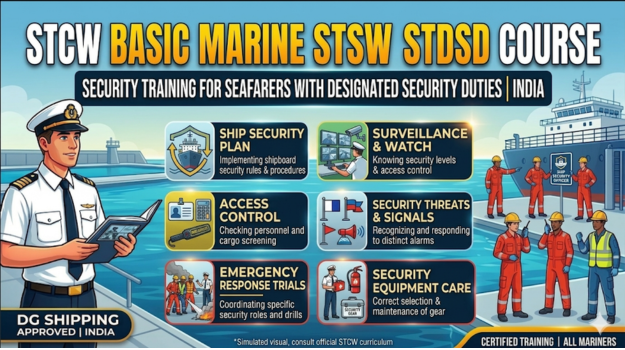
While controlling human access at the gangway is vital, a ship's security can be subtly breached through the very cargo, provisions, and spare parts it takes on board. Smugglers and hostile actors frequently exploit shipping containers, unsealed pallets, or routine ship's stores to introduce contraband, weapons, or dangerous materials onto a vessel. To ensure you completely understand how to mitigate these operational supply chain risks, Nirzara presents the STSDSD Exit Exam Mock - Questions and Answers Set 7. This seventh practice module focuses deeply on cargo security monitoring, verifying ship's stores seals, checking delivery documentation, and preventing structural security compromises.
This specific set on Nirzara contains 30 highly repeated Multiple Choice Questions (MCQs) structured around the latest DG Shipping online portal guidelines. You will face essential STCW questions regarding the verification of container bolt seals, matching delivery notes with the Ship Security Plan (SSP) provisions, scanning cargo manifests for discrepancies, and handling unexpected or unaccompanied packages. Because a single unverified delivery can introduce severe vulnerabilities into a secure maritime environment, the computer-based exam evaluates these supply chain verification steps very strictly.
Every MCQ inside Nirzara's Set 7 comes paired with its verified correct answer, offering an instant checkpoint for your revision. The DG Shipping exam frequently tests precise documentation requirements and security seal inspection protocols to verify your operational accuracy under pressure. Spend a few minutes practicing with these 30 targeted questions today on Nirzara to eliminate confusion, sharpen your exam-taking speed, and comfortably secure your passing marks on the first try!
Practice with 30 questions from the BASIC STSDSD COURSE bank. Each question is verified and explained.
MCQ Practice Questions (30)
Live Mock TestQuestion 1 / 30
Time Left: 15:00
Loading question...
🎉 Mock Test Complete
Your Examination Result
0 / 30
Score Percentage: 0%
Correct
0
Incorrect
0
Skipped
0
1
Whom shall the CSO send he proposed amendment to SSP for approval
aThe Flag state
bThe port state
cThe CSO
dThe owners
Correct Answer: Option A
The Ship Security Plan (SSP) is a mandatory document under SOLAS Chapter XI-2 and the ISPS Code, which must be approved by the Administration. The Administration, in this context, refers to the Flag State under which the ship is entitled to operate, or a Recognized Security Organization (RSO) acting on its behalf. Therefore, any proposed amendments to the already approved SSP must be submitted to the Flag State for review and formal approval to ensure continued compliance with international security standards.
2
Name the document on board which provides the up to date history of the ship since ship building, with respect to name of vessel, ownership, flag state, classification society etc.
aContinuous Synopsis record
bContinuous Symptoms record
cContinuous safety record
dContinuous security record
Correct Answer: Option A
The Continuous Synopsis Record (CSR) is the mandatory document, as per SOLAS, that precisely details the vessel's entire history from construction, including changes in name, ownership, flag, and classification society. This comprehensive record ensures transparency and accountability regarding the ship's identity and statutory compliance. Therefore, Option A accurately identifies the required historical document.
3
The crew is required to know :
alocation and use of emergency equipment
bCasualty handling
cbeing aware not to use elevator in emergency
dall of the above
Correct Answer: Option D
SOLAS and STCW mandates that all crew members possess comprehensive knowledge of emergency equipment locations and operation, casualty handling procedures, and specific emergency protocols such as prohibiting elevator use during emergencies. Therefore, awareness of all these aspects is a fundamental requirement for maritime safety and operational readiness. Option D encompasses all these critical safety knowledge areas essential for every crew member.
4
Each ship shall be verified before the certificate required for the first time
aNo
bYes
Correct Answer: Option B
Before a ship can be issued its certificate for the first time, a thorough verification process is mandated by international regulations like SOLAS to ensure it meets all required safety and operational standards. This initial verification confirms compliance with the relevant conventions and codes, establishing the vessel's seaworthiness and its ability to operate safely. Therefore, the answer is "Yes," as this verification is a prerequisite for certification.
5
The RSO can not do the following for contracting government
aApproval of the ships security plan
bSecurity assessment
cApproval of the amendment of the security plan
dDo the communication during the security incident
Correct Answer: Option D
The Recognized Security Organization (RSO) is an entity designated by a Contracting Government to assess, approve, and audit ship and port facility security plans. While an RSO plays a crucial role in developing and approving security measures, the direct communication during a security incident falls under the responsibility of the ship's Company Security Officer (CSO) and the ship's Master, as outlined by the International Ship and Port Facility Security (ISPS) Code. The RSO's mandate is to provide assessment and approval services, not to actively manage or communicate during an ongoing security event.
6
When in port who does the declaration of security
aSSO & CSO
bSSO & the local coast guard officer
cSSO & the PFSO
dSSO & local agent
Correct Answer: Option C
The Declaration of Security (DoS) is a formal agreement required by SOLAS Chapter XI-2 and the ISPS Code, detailing the security measures to be shared between a ship and a port facility. This critical document must always be completed and signed jointly by the Ship Security Officer (SSO), representing the vessel, and the Port Facility Security Officer (PFSO), representing the port facility, to ensure coordinated and effective security during their interface.
7
The best place to search the individuals physically is
aNear the gangway
bIn a private booth
cOn the bridge
dIn the mess room
Correct Answer: Option B
When searching individuals for security or safety reasons, a private booth is the most appropriate location, ensuring the individual's dignity and privacy are respected while allowing for a thorough examination as mandated by security protocols. This ensures compliance with international regulations concerning personal searches and maintains a professional and secure environment for both the individual being searched and the searcher. Conducting searches in public or highly trafficked areas compromises privacy and could lead to unnecessary distress, which is contrary to best maritime safety practices.
8
ISPS code is applicable to all ships under 500 grt
aTrue
bFalse
Correct Answer: Option B
The ISPS Code, mandated by SOLAS Chapter XI-2, applies to passenger ships regardless of size and cargo ships of 500 gross tonnage and upwards engaged on international voyages. Consequently, the statement is false because the Code generally *does not* apply to cargo ships under 500 GRT, making the blanket assertion incorrect.
9
Most vulnerable place in companionways where we can find drugs and contrabands
aBehind or inside water coolers
bFire Extinguishers
cDucts
dAll of the above
Correct Answer: Option D
Contraband can be concealed in numerous locations within companionways to evade detection, with common hiding spots including water cooler reservoirs, fire extinguisher housings, and ventilation ducts due to their relative inaccessibility and potential for discrete concealment. Therefore, all listed locations represent potential vulnerabilities for illicit cargo, necessitating thorough and comprehensive searches in accordance with maritime security protocols. Adherence to international regulations such as SOLAS and ISPS Code mandates vigilance against such threats.
10
The ISPS code applies to
acargo ships
bpassenger ships
cmobile offshore drilling units
dAll the above
Correct Answer: Option D
The ISPS Code, implemented as an amendment to SOLAS Chapter XI-2, establishes a comprehensive security framework for international shipping and port facilities. Specifically, it applies to passenger ships, cargo ships of 500 gross tonnage and upwards, and mobile offshore drilling units engaged in international voyages. Therefore, all these vessel types are mandated to comply with the Code's stringent security measures and requirements.
11
Which of the following may be available in the safe house or citadel:
aFresh linen
bCCTV display for boarding point, upper deck and bridge
cFridge for provision
dTV for recreation
Correct Answer: Option B
The safe house or citadel is a hardened area designed for crew protection during security threats, and its primary function necessitates the ability to monitor external conditions. Consequently, a CCTV display providing critical views of boarding points, upper deck, and the bridge is an essential security feature, enabling the crew to maintain situational awareness and relay vital intelligence while secure. This capability directly supports maritime security protocols and the effective use of a citadel as a defensive measure.
12
why do we need to open the escape door from outside
aFor pleasure
bFor safety rounds
cFor emergency
dFor alternative route
Correct Answer: Option C
Opening escape doors from the outside is a critical emergency procedure mandated by SOLAS to ensure immediate access for rescue personnel or crew during an emergency, providing an alternative means of egress when primary routes are compromised. This capability allows for rapid response and evacuation, directly contributing to the safety of life at sea. Therefore, it is specifically for emergency situations where immediate external access is paramount for survival.
13
Where is the guidance for risk based assessment available
aIn RA manual
bIn STCW code
cIn ISPS code part A
dIn ISPS code part B
Correct Answer: Option D
The ISPS Code Part B provides the detailed, recommended guidance for conducting various risk-based assessments, such as Ship Security Assessments (SSA) and Port Facility Security Assessments (PFSA). While Part A of the ISPS Code contains the mandatory requirements for maritime security, Part B offers the interpretive and explanatory provisions necessary to properly implement those requirements and methodologies. This distinction ensures that the *how-to* guidance for effective risk assessment is readily available for compliance.
14
Who is responsible for maintenance of the security equipment on board:
aThe safety officer
bThe ship Security Officer
cThe Duty Officer
dThe Chief Engineer
Correct Answer: Option B
The Ship Security Officer (SSO) is explicitly responsible for the maintenance of all ship security equipment as mandated by the International Ship and Port Facility Security (ISPS) Code, which is an integral part of SOLAS. This role ensures the integrity and functionality of systems designed to prevent unauthorized access and protect the vessel and its cargo from security threats. Other officers may have secondary roles or be delegated specific tasks, but overall responsibility rests solely with the SSO.
15
Port facility includes location where the ship/port interface takes place;
aTrue
bFalse
Correct Answer: Option A
The statement is unequivocally true. As explicitly defined within the International Ship and Port Facility Security (ISPS) Code, which is integral to SOLAS Chapter XI-2 on Maritime Security, a "port facility" specifically denotes the location where the ship/port interface takes place. This interface is where essential operations such as cargo handling, passenger embarkation/disembarkation, bunkering, and security protocols between the vessel and the land facility occur.
16
Which of these indicators that an individual may be a drug smuggler
aThe individual spends his or her free time laying out with others
bThe individual wears bulky or out of season clothing
cThe individual makes small local purchases
dIndividual is disinterested in the ships cargo
Correct Answer: Option D
Disinterest in the ship's legitimate cargo is a key indicator of potential illicit activity, as individuals involved in smuggling prioritize the concealment and transport of their contraband over the vessel's declared manifest or normal operations. Such a lack of engagement suggests their presence on board serves an ulterior, unlawful purpose, deviating from expected behavior of legitimate crew or passengers. This behavioral anomaly aligns with indicators maritime security protocols, informed by SOLAS and the ISPS Code, train personnel to identify for preventing illicit cargo and personnel movement.
17
"Under ISPS code describes the current scenario related to the security threat to the country and its coastal region including the ships visiting that country"
aExchange rate
bGDP
cDaily news channels
dSecurity levels
Correct Answer: Option D
Under the ISPS Code, "Security levels" (Level 1, 2, or 3) are the precise and formal mechanism designated by Contracting Governments to describe the current security threat scenario for a country, its coastal region, and all ships and port facilities within its jurisdiction. These levels directly communicate the degree of risk of a security incident and mandate specific, corresponding security measures to be implemented by ships and port facilities. This standardized system ensures an appropriate and coordinated response to evolving maritime security threats.
18
Where do we find documentary evidence of masters overriding authority?
aIn masters contract
bIn masters standing over notes
cIn SSP
dIn companies’ website
Correct Answer: Option C
The documentary evidence of the Master's overriding authority, particularly regarding security matters, is explicitly found in the Ship Security Plan (SSP). This is mandated by the International Ship and Port Facility Security (ISPS) Code, a component of SOLAS Chapter XI-2, which requires clear definition of the Master's ultimate decision-making power for the safety and security of the vessel, crew, and cargo in all circumstances, including overriding company instructions if necessary. This provision ensures immediate and decisive action can be taken in the face of security threats.
19
The SSAS shall be transmitted to
aThe local port authority
bThe Flag state of its designated competent
authority
cThe ships owner
dThe ships agent
Correct Answer: Option B
The Ship Security Alert System (SSAS) is a critical component of maritime security, mandated by SOLAS Chapter XI-2 and the ISPS Code. Its primary function is to transmit a silent alert directly to the vessel's Flag State or its designated competent authority. This ensures that the sovereign state responsible for the ship's security receives immediate notification, enabling a coordinated and timely response from national security agencies during a security incident.
20
Crowd management and control techniques have the following parts
aLife saving appliance and control plans
bAssisting passengers en route to assembly and embarkation stations
cMustering procedures
dAll of the above
Correct Answer: Option D
According to SOLAS and STCW regulations, effective crowd management encompasses all listed aspects: life-saving appliance and control plans are crucial for organized evacuation, assisting passengers en route to assembly and embarkation stations ensures their safe and orderly progress, and mustering procedures provide the framework for accounting for everyone. Therefore, "All of the above" correctly identifies the comprehensive nature of crowd management and control techniques required for maritime safety.
21
Drills are more supervised activities that are used to test a single measure of procedure in the SSP
aTrue
bFalse
Correct Answer: Option A
Drills, as defined and mandated by SOLAS and STCW, are indeed supervised exercises designed to assess proficiency in specific emergency procedures within a vessel's Safety Management System (SMS), not broad procedural testing. Therefore, the statement accurately reflects the focused nature of drills.
22
For security level 3
ano additional personnel are required
bsame crew as the other security levels to be keep
cAdditional crew to be put on security duty
dRequire to call security personal from ashore
Correct Answer: Option C
For Security Level 3, which indicates a probable or imminent security incident, the ISPS Code mandates the application of all relevant protective security measures. To effectively implement these stringent measures, which include intensified access control, enhanced watch keeping, and specific defensive actions, additional crew members must be assigned to dedicated security duties. This augmentation ensures the necessary vigilance and response capability required to mitigate a severe threat.
23
Seafarers with designated security duties are not responsible for;
aKnowledge of methods of physical searches of ships stores
bKnowledge of operation of security systems
cKnowledge of calibration of security equipment and systems
dSecurity assessment of the ship
Correct Answer: Option D
The Ship Security Assessment (SSA) is a highly specialized and comprehensive process primarily overseen by the Company Security Officer (CSO) to identify and evaluate security risks, threats, and vulnerabilities. This critical assessment forms the foundation for developing the Ship Security Plan (SSP) and is a management-level responsibility, distinct from the operational duties of seafarers with designated security duties (DSD). DSD personnel are trained to implement the SSP, not to conduct its initial, in-depth security assessment.
24
What percentage of the ship stores are required to be inspected security level 3;
a25 – 50 % of ships stores
b5 – 20 % of ships stores
c100% of ships stores
d50 – 80% of ships stores
Correct Answer: Option C
Under SOLAS Chapter XI-2 and the ISPS Code, all ship stores, regardless of quantity, are subject to security screening, thus requiring 100% inspection for security level 3. This comprehensive approach is mandated to prevent unauthorized items or persons from being introduced to the vessel, ensuring the highest level of maritime security. Therefore, a full inspection of all ship stores is necessary when security level 3 is declared.
25
The amendments to code by IMO resolution MSC 196 (80) was adopted on;
a20-05-2005
b20-05-2006
c20-05-2007
d20-05-2008
Correct Answer: Option A
IMO Resolution MSC.196(80), adopting amendments to the International Convention for the Safety of Life at Sea (SOLAS), was officially adopted on 20 May 2005. This date signifies the formal acceptance and approval of these specific SOLAS amendments by the Maritime Safety Committee. Adherence to the adoption date is crucial for understanding the effective implementation and regulatory application of these critical safety provisions.
26
The ISPS code does not apply to warships, naval auxiliaries or other ships owned or operated by a contracting government and used only for government non commercial service
ano
byes
Correct Answer: Option B
Yes, the statement is correct. The ISPS Code, specifically Section A/3.2, explicitly states its non-applicability to warships, naval auxiliaries, and other ships owned or operated by a Contracting Government when used only for government non-commercial service. This exemption is due to their sovereign nature and distinct operational profile, which falls outside the commercial maritime security scope the Code is designed to regulate.
27
Who shall be involved in the ship shore security drill
aShip security officers
bCompany security officers
cContracting government
dAll the above
Correct Answer: Option D
A ship-shore security drill, mandated by the International Ship and Port Facility Security (ISPS) Code, requires the active involvement of the Ship Security Officer (SSO) for onboard execution and the Company Security Officer (CSO) for oversight and compliance with the Ship Security Plan. Additionally, the Contracting Government, through its Designated Authority and Port Facility Security Officer (PFSO), represents the critical shore-side element, ensuring the Port Facility Security Plan is effectively integrated and tested against the ship's procedures. Consequently, thorough testing of the ship/port interface and adherence to international maritime security standards necessitate the participation of all these roles.
28
Which ship board personnel should be able to recognize and detect weapons, dangerous substances and devices
aSSO
bMaster
cDuty officer
dAll ship board personnel
Correct Answer: Option D
The correct answer is Option D, "All ship board personnel." While the Ship Security Officer (SSO) and Master have primary responsibility for security implementation, the International Ship and Port Facility Security (ISPS) Code, part of SOLAS Chapter XI-2, mandates that all shipboard personnel receive security awareness training. This training ensures every crew member can recognize and report potential security threats, including weapons, dangerous substances, and devices, making their collective vigilance critical to the vessel's overall security posture.
29
Who shall decide the duration for which we need to keep the security record onboard
aThe CSO
bThe SSO
cThe Flag state administration
dThe Master
Correct Answer: Option C
The Flag State administration is ultimately responsible for deciding the duration for which security records must be kept onboard, as mandated by the International Ship and Port Facility Security (ISPS) Code, part of SOLAS Chapter XI-2. While the ISPS Code specifies minimum retention periods (e.g., 12 months for certain records), it is the Flag State's prerogative and responsibility to establish the precise national requirements for vessels registered under its flag, which may exceed international minimums. This ensures consistent application of security standards across its fleet.
30
All ships staff are not required to have detailed knowledge of following;
aThe ISPS code in full
bTechniques used to circumvent security measures
cThe contingency plans
dRecognition and detection of the weapons
Correct Answer: Option A
While all ship's staff require awareness of security protocols, only designated security personnel need comprehensive, detailed knowledge of the ISPS Code in its entirety. STCW and SOLAS place the onus for understanding the full ISPS Code on Company and Ship Security Officers, not every individual crew member.
About Me
NIRZARA TEAM
Author & Contributor
The Nirzara Team is a group of dedicated marine professionals and educators committed to improving maritime learning through digital education. Our team works to provide quality study materials, practical knowledge, and career guidance to support seafarers and marine students worldwide.