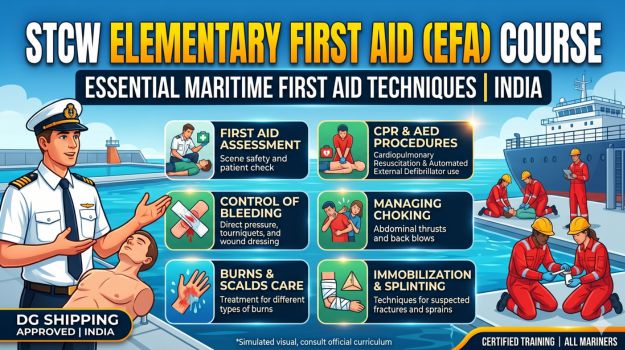
Mastering the Elementary First Aid (EFA) module is a vital step for every seafarer, and clearing the DG Shipping online test requires thorough preparation. To help you sail through smoothly, we have launched the EFA Exit Exam Mock - Questions and Answers Set 1. This comprehensive practice set consists of 30 highly repeated Multiple Choice Questions (MCQs) that perfectly match the latest STCW and DG Shipping exam patterns.
This specific set focuses on the core fundamentals of maritime medical emergencies. By practicing these questions, you will test your knowledge on crucial topics such as Cardiopulmonary Resuscitation (CPR) steps, handling severe bleeding, managing fractures, treating burns, and responding to choking incidents on board. Understanding how to react during the golden hour of an accident can save lives at sea, making this mock test both a career necessity and a practical life skill.
Why choose our EFA Set 1? Every question comes with the correct answer, allowing you to self-evaluate instantly. Practicing this mock test helps you improve your speed, reduce exam anxiety, and get familiar with the tricky phrasing often used in the actual computer-based test. Don’t leave your maritime career certificates to chance. Start practicing with Set 1 today, identify your weak areas, and score a perfect 100% on your very first attempt!
Practice with 30 questions from the BASIC EFA COURSE bank. Each question is verified and explained.
MCQ Practice Questions (30)
Live Mock TestQuestion 1 / 30
Time Left: 15:00
Loading question...
🎉 Mock Test Complete
Your Examination Result
0 / 30
Score Percentage: 0%
Correct
0
Incorrect
0
Skipped
0
1
What is the *first* and most important step to take when approaching an emergency scene on a vessel where a crew member is injured?
aImmediately check the casualty's breathing and pulse.
bCall for medical assistance or the ship's officer on duty.
cEnsure the scene is safe for yourself, the casualty, and others.
dBegin administering first aid treatment without delay.
Correct Answer: Option C
Before providing any assistance, it is paramount to ensure the scene is safe. This means checking for ongoing dangers like fire, toxic fumes, unstable structures, or moving machinery that could injure you or the casualty further. Your safety is always the first priority in any emergency situation to prevent additional casualties.
2
When performing Cardiopulmonary Resuscitation (CPR) on an adult aboard a ship, what is the recommended depth for chest compressions?
aAt least 1 inch (2.5 cm)
bApproximately 1.5 inches (3.8 cm)
cAt least 2 inches (5 cm) but no more than 2.4 inches (6 cm)
dAs deep as possible without causing further injury to the casualty.
Correct Answer: Option C
Current guidelines for adult CPR recommend chest compressions that are at least 2 inches (5 cm) deep but no more than 2.4 inches (6 cm). This depth ensures adequate blood flow to the brain and other vital organs, while avoiding excessive force that could cause injury.
3
A crew member has a severe cut on their forearm from a piece of equipment, resulting in heavy bleeding. What is the most effective initial first aid action to control this bleeding?
aElevate the injured limb above the heart.
bApply a tourniquet immediately above the wound.
cApply direct, firm pressure to the wound using a clean dressing.
dPour antiseptic solution directly onto the wound to clean it.
Correct Answer: Option C
For severe external bleeding, the most effective initial method is to apply direct, firm pressure to the wound with a clean dressing (or your hand if no dressing is available). This helps the blood to clot and stops the flow. Elevation and tourniquets are secondary measures if direct pressure is insufficient or impractical, and cleaning the wound is done after bleeding is controlled.
4
A fellow seafarer suddenly grabs their throat, cannot speak, and appears to be struggling to breathe after eating. They are clearly choking. What is the appropriate first aid response?
aOffer them water to drink to help dislodge the obstruction.
bEncourage them to cough forcefully and monitor them.
dLay them down on their back and elevate their legs.
Correct Answer: Option C
When a conscious person is choking severely (unable to speak, cough, or breathe), the appropriate first aid action is to perform abdominal thrusts (Heimlich maneuver). This technique helps to force air out of the lungs, creating an artificial cough to expel the object blocking the airway. Encouraging them to cough is only effective if they can cough forcefully.
5
A person suffers a superficial burn on their hand from touching a hot surface in the engine room. After ensuring safety, what is the immediate and most important first aid step?
aApply ice directly to the burn.
bCover the burn with a sterile bandage.
cCool the burn under cool running water for at least 10-20 minutes.
dApply butter, oil, or a burn cream to the affected area.
Correct Answer: Option C
The immediate first aid for a burn (after ensuring safety) is to cool the burn under cool (not cold or icy) running water for at least 10 to 20 minutes. This helps to stop the burning process, reduce pain, and minimize tissue damage. Applying ice directly can cause frostbite, and applying substances like butter or oil can trap heat and increase the risk of infection.
6
Why is it important to place an unconscious but breathing casualty in the recovery position, especially in a marine environment?
aTo make them more comfortable and relaxed.
bTo prevent them from accidentally rolling off a bunk or stretcher.
cTo keep their airway open and prevent vomit or fluids from entering their lungs.
dTo help them warm up if they are suffering from hypothermia.
Correct Answer: Option C
The primary purpose of the recovery position is to maintain an open airway and prevent aspiration (inhaling vomit or fluids). An unconscious person's tongue can fall back and block their airway, or they may vomit. Placing them on their side with their head tilted ensures that the airway remains clear and any fluids can drain out of the mouth, which is crucial in any environment, including marine.
7
A crew member has been rescued from cold water and is showing signs of mild hypothermia (shivering, confusion, pale skin). What is the best initial first aid response?
aGive them a hot alcoholic drink to warm them quickly.
bRub their limbs vigorously to stimulate circulation.
cRemove wet clothing, wrap them in dry blankets, and provide warm, non-alcoholic drinks.
dImmerse them in a hot bath or shower immediately to raise their core temperature.
Correct Answer: Option C
For mild hypothermia, the best approach is gentle rewarming. This involves removing all wet clothing, drying the person, and wrapping them in multiple layers of dry blankets or warm clothing. Providing warm, non-alcoholic drinks helps to rewarm them internally. Alcohol can worsen hypothermia, vigorous rubbing can be harmful, and rapid external rewarming (like a hot bath) can cause dangerous shifts in blood pressure.
8
If a crew member sustains a suspected fracture to their leg after a fall on deck, what is the most important first aid principle when preparing to move them to a safer area or for further medical attention?
aMove them as quickly as possible to avoid further pain.
bAttempt to straighten the limb to its normal position before moving.
cImmobilize the suspected fractured limb using a splint or sling before any movement.
dElevate the limb as high as possible and apply firm pressure to the injury.
Correct Answer: Option C
The most important principle when dealing with a suspected fracture is to immobilize the injured limb before any movement. This helps to prevent further damage to bones, nerves, and blood vessels, and reduces pain. Attempting to straighten the limb or moving without stabilization can cause severe complications.
9
Which of the following signs and symptoms are most commonly associated with a casualty experiencing shock due to a severe injury or illness?
aFlushed, hot skin; slow, strong pulse; elevated blood pressure.
cNormal skin color and temperature; deep, slow breathing; normal pulse.
dRed, dry skin; slow, irregular pulse; confusion and agitation.
Correct Answer: Option B
Shock is a life-threatening condition where the body isn't getting enough blood flow. Common signs include pale, cool, and clammy skin (due to blood being diverted from the skin), rapid and shallow breathing, and a rapid, weak pulse. Other signs can include confusion, dizziness, and weakness. Recognizing these signs is crucial for early intervention.
10
When using an Automated External Defibrillator (AED) on a casualty experiencing sudden cardiac arrest on a vessel, what is a crucial safety consideration before delivering a shock?
aEnsure the casualty is completely dry and the area around them is clear and not wet.
bApply alcohol to the chest before attaching the AED pads for better conductivity.
cContinue performing chest compressions while the AED delivers a shock to maintain blood flow.
dPlace the AED pads directly over any metallic jewelry or body piercings if they are in the way.
Correct Answer: Option A
Water is an electrical conductor, and using an AED in a wet environment can pose a risk of electric shock to rescuers or bystanders. It is crucial to ensure the casualty is as dry as possible and that the area around them is not wet before delivering a shock. All persons must also stand clear during the shock delivery. Alcohol is not used with AED pads, chest compressions are paused during shock, and jewelry/piercings should be removed or worked around.
11
What is the FIRST step you should take when approaching an injured person to provide first aid?
aCheck for danger to yourself and the casualty.
bShout for help from others nearby.
cCheck if the person is conscious.
dStart giving chest compressions immediately.
Correct Answer: Option A
The primary concern in any first aid situation is always safety. Before doing anything else, you must ensure the area is safe for yourself, any bystanders, and the casualty. This is the 'Danger' part of the DRSABC (Danger, Response, Shout for help, Airway, Breathing, Circulation) action plan.
12
For an adult casualty who is unconscious and not breathing normally, what is the recommended depth for chest compressions during CPR?
aApproximately 1-2 cm (0.5-1 inch)
bApproximately 3-4 cm (1.2-1.6 inches)
cApproximately 5-6 cm (2-2.4 inches)
dApproximately 7-8 cm (2.8-3.1 inches)
Correct Answer: Option C
Current international first aid guidelines recommend a compression depth of approximately 5-6 cm (2-2.4 inches) for adults to effectively circulate blood to vital organs. Compressions should be hard and fast, at a rate of 100-120 per minute.
13
If a crew member suffers a severe cut on their arm and is bleeding heavily, what is the immediate priority for first aid?
aApply a tourniquet above the wound.
bElevate the injured arm above the heart.
cApply direct pressure to the wound with a clean dressing.
dWash the wound thoroughly with seawater.
Correct Answer: Option C
The most effective and immediate way to control severe external bleeding is to apply firm, direct pressure to the wound using a clean dressing, a sterile pad, or even your hand if nothing else is available. Elevating the limb can help reduce blood flow, but direct pressure is the primary action. Tourniquets are for life-threatening bleeding not controlled by direct pressure and are a last resort. Washing with seawater could introduce infection.
14
A person onboard has been involved in an accident and is showing signs of shock (pale, cold, clammy skin, rapid shallow breathing). What is the best first aid action to take?
aGive them a hot sugary drink to warm them up.
bHelp them sit upright and keep them awake.
cLay them down, elevate their legs (if no injury to legs or head), and keep them warm.
dEncourage them to walk around to improve circulation.
Correct Answer: Option C
For a casualty showing signs of shock, the recommended first aid includes lying them down (often with legs elevated slightly to encourage blood flow to vital organs, unless there is a head or leg injury), keeping them warm with blankets, and reassuring them. Giving drinks is usually avoided as they might vomit or require surgery. Walking around would worsen their condition.
15
While working on deck in cold weather, a crew member becomes confused, shivers uncontrollably, and has pale, cold skin. These are symptoms of:
aHeatstroke
bHypoglycemia
cHypothermia
dHyperventilation
Correct Answer: Option C
Hypothermia is a dangerous drop in body temperature, often caused by prolonged exposure to cold environments, which is highly relevant in marine settings. Confusion, uncontrollable shivering, and pale, cold skin are classic signs. Heatstroke is from overheating, hypoglycemia is low blood sugar, and hyperventilation is rapid breathing.
16
A small burn on a crew member's hand from hot steam should primarily be treated by:
aApplying ice directly to the burn.
bBreaking any blisters that form.
cCooling the burn under cool running water for at least 10-20 minutes.
dApplying butter or oil to the burn.
Correct Answer: Option C
The immediate and most effective first aid for a burn is to cool it with cool (not ice-cold) running water for a sustained period (10-20 minutes or longer). This helps reduce pain, swelling, and further tissue damage. Ice can cause frostbite, breaking blisters increases infection risk, and applying butter or oil can trap heat and worsen the burn.
17
An adult crew member is suddenly unable to speak, cough, or breathe after eating, clutching their throat. What is the most appropriate first aid action?
aGive them sips of water.
bEncourage them to cough forcefully.
cPerform abdominal thrusts (Heimlich maneuver).
dSlap them gently on the back.
Correct Answer: Option C
When an adult is experiencing severe choking (unable to speak, cough, or breathe), the recommended first aid sequence involves alternating between back blows and abdominal thrusts (Heimlich maneuver). If initial back blows are unsuccessful, abdominal thrusts should be performed. Giving water could worsen the obstruction, and encouraging a cough is for mild choking where they can still cough.
18
When assisting a crew member with a suspected fracture to their lower leg, what is the most important principle of first aid?
aTry to realign the bone before splinting.
bKeep the injured leg moving to prevent stiffness.
cImmobilize the injured area, including the joints above and below the fracture.
dApply a heat pack to the site of the injury to reduce pain.
Correct Answer: Option C
For a suspected fracture, the primary goal is to immobilize the injured area to prevent further damage, reduce pain, and minimize swelling. This typically involves splinting the limb to include the joint immediately above and below the suspected fracture site. Realignment should only be attempted by medical professionals, movement is harmful, and heat packs are generally not recommended for acute injuries due to increased swelling.
19
You find an unconscious crew member on deck, but they are breathing normally. What is the best position to place them in while waiting for medical assistance?
aFlat on their back with their head tilted back.
bSitting upright to keep their airway open.
cIn the recovery position (on their side).
dOn their stomach with their head turned to the side.
Correct Answer: Option C
An unconscious person who is breathing normally should be placed in the recovery position (on their side) to help maintain an open airway and prevent them from choking on vomit or fluids. Lying flat on their back could lead to airway obstruction if their tongue falls back or if they vomit.
20
Which of the following items is NOT typically considered a basic essential component of a standard first aid kit on a vessel?
aSterile adhesive dressings and bandages.
bAntiseptic wipes or solution.
cPrescription antibiotics.
dDisposable gloves.
Correct Answer: Option C
While a well-stocked marine first aid kit (especially for longer voyages) might contain a broader range of medications, prescription antibiotics are generally *not* considered a basic essential component for an 'Elementary First Aid' kit, as they require a medical diagnosis and prescription. Sterile dressings, antiseptic wipes, and disposable gloves are fundamental for managing common injuries and preventing infection.
21
What is the *first* step you should take when approaching a casualty in a marine environment, assuming the scene is safe?
aCheck for breathing.
bCall for medical assistance.
cAssess for dangers to yourself and the casualty.
dBegin chest compressions.
Correct Answer: Option C
According to the DRSABCD action plan (Danger, Response, Send for help, Airway, Breathing, CPR, Defibrillation), the very first step is to assess for 'Danger'. Ensuring the scene is safe for both yourself and the casualty is paramount before any other action is taken, especially in a potentially hazardous marine environment.
22
A crew member on deck has sustained a deep cut and is bleeding heavily. What is the immediate priority for managing severe external bleeding?
aApply a tourniquet immediately.
bElevate the injured limb above the heart.
cApply direct pressure to the wound with a clean dressing.
dWash the wound thoroughly with seawater.
Correct Answer: Option C
The most effective and immediate first aid for severe external bleeding is to apply direct pressure to the wound with a clean dressing or your hand. This helps to stem the flow of blood and promotes clotting. Elevating the limb can be a secondary measure, and tourniquets are generally reserved for life-threatening bleeding not controlled by direct pressure. Washing with seawater could introduce infection.
23
When performing Cardiopulmonary Resuscitation (CPR) on an adult, what is the correct compression-to-breath ratio?
a15 compressions to 2 breaths
b30 compressions to 2 breaths
c5 compressions to 1 breath
d30 compressions to 5 breaths
Correct Answer: Option B
For adult CPR, the internationally recognized standard ratio is 30 chest compressions followed by 2 rescue breaths. This cycle should be continued without interruption until professional medical help arrives or the casualty shows signs of recovery.
24
A person has been rescued from cold seawater and is showing signs of moderate hypothermia (shivering, confusion). What is the most appropriate initial first aid action?
aGive them sips of hot coffee or alcohol.
bRub their skin vigorously to create warmth.
cRemove wet clothing, cover with dry blankets, and provide warm, sweet drinks if conscious.
dImmerse them in hot water to warm them up quickly.
Correct Answer: Option C
For a conscious casualty with moderate hypothermia, the best approach is gentle rewarming. Removing wet clothing prevents further heat loss, and covering with dry blankets or sleeping bags conserves body heat. Warm, sweet drinks provide energy and help warm the body internally. Avoid alcohol (which can cause further heat loss), vigorous rubbing (which can drive cold blood to the heart), and rapid rewarming techniques like hot baths, which can be dangerous.
25
An adult crew member is conscious but suddenly clutching their throat and unable to speak or cough. What is the first action you should take?
aAdminister chest compressions.
bEncourage them to cough forcefully.
cGive up to 5 sharp blows between the shoulder blades.
dPerform the Heimlich maneuver immediately.
Correct Answer: Option C
For a conscious adult who is choking and unable to clear the obstruction, the recommended first action is to administer up to 5 sharp back blows between the shoulder blades. If this does not clear the obstruction, then abdominal thrusts (Heimlich maneuver) should be performed.
26
A crew member has been stung by a jellyfish. After ensuring your own safety, what is the recommended immediate first aid for most common jellyfish stings?
aRub the affected area vigorously with sand.
bApply ice directly to the sting.
cRinse the area thoroughly with seawater or vinegar (if available and specific to species).
dApply a pressure immobilization bandage.
Correct Answer: Option C
For most common jellyfish stings, rinsing the affected area with seawater (or vinegar for some specific species, like Box Jellyfish, if available) helps to neutralize or remove remaining stinging cells (nematocysts) without triggering more venom release. Fresh water can worsen stings, and rubbing with sand can embed more stingers. Ice can help with pain but is not the primary treatment for neutralizing the venom.
27
A crew member accidentally spills hot engine oil on their arm, causing a superficial burn. What is the immediate and most effective first aid treatment for this burn?
aApply ice directly to the burn.
bCover the burn with butter or oil.
cRun the burn under cool, running water for at least 10-20 minutes.
dPuncture any blisters that form.
Correct Answer: Option C
The immediate and most effective first aid for a burn is to cool the affected area under cool, running water for a minimum of 10-20 minutes. This helps to reduce pain, swelling, and further tissue damage. Do not use ice, butter, oils, or puncture blisters, as these can cause further harm or infection.
28
A casualty is showing signs of shock (pale, cold, clammy skin, rapid pulse, weakness) after an injury. What is the primary goal of first aid for shock?
aTo get them to stand up and walk around.
bTo raise their legs, keep them warm, and reassure them while seeking medical help.
cTo give them a strong stimulant like coffee.
dTo apply a hot pack to their chest.
Correct Answer: Option B
The primary goal of first aid for shock is to improve blood flow to vital organs. This involves laying the casualty down, elevating their legs (if no spinal injury is suspected), maintaining their body temperature by covering them, and providing reassurance. Seeking urgent medical help is crucial. Stimulants or extreme heat/cold are not appropriate treatments for shock.
29
A crew member has fallen from a ladder onto a hard deck and is complaining of neck pain. What is the most important first aid principle when managing a suspected spinal injury?
aMove them quickly to a comfortable position.
bEncourage them to sit up and check if they can move their limbs.
cKeep the head and spine in a neutral position and minimize movement.
dApply heat packs to the injured area.
Correct Answer: Option C
When a spinal injury is suspected, the absolute priority is to minimize any movement of the head and spine. This is done to prevent further damage to the spinal cord, which could lead to paralysis or other severe complications. Maintaining a neutral, in-line position and providing manual stabilization until professional help arrives is critical.
30
When making an urgent medical request (e.g., via VHF radio or satellite phone) for a serious illness or injury on board, what crucial information should be included?
aOnly the vessel's name and position.
bThe casualty's name, age, and a brief description of their favourite food.
cVessel's identity, position, nature of illness/injury, number of casualties, and initial first aid given.
dThe next port of call and estimated time of arrival.
Correct Answer: Option C
When communicating a medical emergency, providing comprehensive information allows shore-based medical teams or rescue coordinators to offer the best advice and prepare for potential evacuation. Essential details include who you are (vessel identity), where you are (position), what happened (nature of illness/injury), how many people are affected (number of casualties), and what immediate steps you have already taken (initial first aid given). This aligns with established maritime distress communication protocols.
About Me
NIRZARA TEAM
Author & Contributor
The Nirzara Team is a group of dedicated marine professionals and educators committed to improving maritime learning through digital education. Our team works to provide quality study materials, practical knowledge, and career guidance to support seafarers and marine students worldwide.