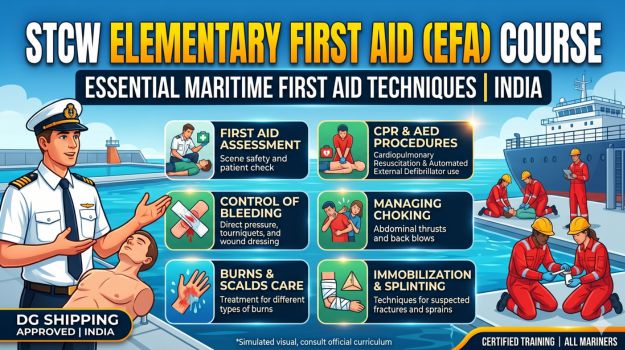
Maintaining peak health standards and handling minor medical crises before they escalate is a daily responsibility on any vessel. To help you master these skills, Nirzara presents the EFA Exit Exam Mock - Questions and Answers Set 7. This seventh installment features 30 highly relevant Multiple Choice Questions (MCQs) that focus on a mix of everyday shipboard hygiene, infection control, and specific localized injuries like eye accidents.
Seafarers frequently work with dust, chipping rust, and dangerous chemicals, making eye injuries a common hazard on deck. In this set on Nirzara, you will face critical questions on how to correctly flush a foreign particle from the eye, treating minor chemical splashes, and preventing cross-contamination when treating wounds. Additionally, the STCW framework expects you to understand basic infection prevention in a confined environment, which is precisely what these 30 questions evaluate.
Every MCQ in Set 7 comes paired with its verified correct answer, giving you immediate feedback to correct your mistakes on the spot. Nirzara's clean and structured layout allows you to study under realistic exam conditions, ensuring that confusing phrasing doesn't trip you up in the actual DG Shipping online portal. Spend some time practicing with Set 7 today to sharpen your reflexes, solidify your theoretical foundation, and guarantee your passing score on the very first try!
Practice with 30 questions from the BASIC EFA COURSE bank. Each question is verified and explained.
MCQ Practice Questions (30)
Live Mock TestQuestion 1 / 30
Time Left: 15:00
Loading question...
🎉 Mock Test Complete
Your Examination Result
0 / 30
Score Percentage: 0%
Correct
0
Incorrect
0
Skipped
0
1
Pick one of the following familial factors that plays a role in the development of eating disorders ?
aParental attitudes to sex
bParental obesity
cParental attitudes to the media
dParental attitudes to education
Correct Answer: Option B
While SOLAS, STCW, and marine engineering standards primarily focus on vessel safety and operations, understanding crew welfare is integral to maritime safety. Parental obesity (Option B) is a recognized familial factor that can contribute to the development of eating disorders, potentially impacting a seafarer's physical and mental health, and thus their operational effectiveness and safety at sea. The other options are not directly linked to the physiological or psychological predispositions commonly associated with eating disorders in familial contexts relevant to crew well-being.
2
Which of the following is a laboratory procedure developed to provide an objective behavioural measure of the tendency to binge eat
aPalatability test
bFood pre-load test
cFull capacity test
dFully loaded test
Correct Answer: Option B
The food pre-load test is a controlled laboratory procedure designed to assess an individual's food intake after a standardized initial meal, providing an objective behavioral measure of the tendency for binge eating. This methodology directly relates to understanding physiological and psychological responses to food intake, which can be relevant in evaluating crew well-being and operational readiness in a maritime context.
3
A high-fiber, low-fat diet and regular exercise can help to ____.
aIncrease CVD
bIncrease weight
cLose weight
dNone
Correct Answer: Option C
A high-fiber, low-fat diet and regular exercise promote cardiovascular health and metabolism, which are crucial for maintaining optimal physical condition required by STCW for seafarers. This combination actively contributes to a healthy body mass index and facilitates weight loss or maintenance, directly supporting the operational readiness and well-being mandated for maritime professionals.
4
Which of the following is not a good approach to managing stress
aTalking directly to the person who is causing the stress
bGiving yourself a treat like comfort food or a cocktail
cAccepting that there are things beyond your control
dTrying cognitive-therapy to learn new coping skills
Correct Answer: Option B
While options A, C, and D represent proactive and constructive strategies aligned with maritime safety principles for managing stress, Option B offers a temporary, potentially unhealthy coping mechanism. Unmanaged stress can compromise decision-making and operational efficiency, directly impacting safety as mandated by STCW and SOLAS regulations concerning crew welfare and performance.
5
Advance communications system and technology stipulated by WHO where medical advice can be sought by
aTele medicine
bSatellite communication
cRadio medical advice
dCompulsory in board specialized
Correct Answer: Option C
Radio medical advice, as stipulated by SOLAS and recognized by the WHO, is the established and mandated system for seeking medical guidance at sea. While telemedicine and satellite communication are enabling technologies, they are not the direct communication channel itself for official medical advice as per international maritime regulations. This ensures consistent access to essential medical support for vessels.
6
The content of the first aid kit include the following except
aMicropore
bMacropore
cBandages
dScissor
Correct Answer: Option B
As per the requirements outlined in SOLAS Chapter VI and STCW Code Table VI/4-2, a first aid kit must contain essential wound care supplies. While micropore tape, bandages, and scissors are standard components for treating injuries, macropore materials are not specified or required for a vessel's first aid kit. Therefore, macropore is the item that would not be included.
7
You are alone and administering CPR to an victim. How many chest compression and how many inflations should you administer in each sequence ?
a15 compression then 2 inflations
b15 compression then 4 inflations
c30 compression then 2 inflations
d30 compression then 4 inflations
Correct Answer: Option C
The correct ratio for CPR when administering it alone to an adult victim is 30 chest compressions followed by 2 rescue breaths, a standard established by leading maritime safety organizations to maximize the effectiveness of resuscitation efforts and align with global resuscitation guidelines for single rescuers. This sequence ensures adequate blood circulation and oxygenation, critical for patient survival during maritime emergencies. Adherence to this ratio is a fundamental component of the medical first aid training required under STCW regulations for all seafarers.
8
Before giving CPR you should make sure ?
aThey are not bleeding
bThey are conscious or unconscious
cThey are not vomiting
dThey are not dead
Correct Answer: Option B
Before initiating CPR, it is paramount to confirm the casualty's state of consciousness, as CPR is a life-saving intervention for those who are unresponsive. This assessment, vital for proper emergency response protocols and mandated by maritime safety standards, dictates the immediate course of action. Therefore, confirming consciousness or unconsciousness is the critical first step in determining the necessity and applicability of CPR.
9
If a person is chocking you should do nothing as long as
aThey are coughing
bThey are still conscious
cTheir face has not turned blue
dThey start crying
Correct Answer: Option A
If a person is choking, you should do nothing as long as they are able to cough, as this indicates they are still expelling the obstruction themselves. Intervening prematurely with first aid when spontaneous coughing is occurring could dislodge the object in a way that makes it more difficult to remove or cause further harm.
10
What does the ABC’s for first aid stand for ?
aThe letters in the alphabet
b.
c. *
d.
bAir, breathing, circulation
cAirway , breathing, circulation
dNone of the above
Correct Answer: Option C
The ABC's of first aid stand for Airway, Breathing, and Circulation, a standardized protocol for assessing and managing life-threatening emergencies vital for maritime safety under STCW regulations. This sequence prioritizes establishing a clear airway, ensuring adequate breathing, and then addressing circulation to restore vital functions. Adherence to these fundamental principles is paramount for effective emergency response at sea, as mandated by international maritime safety standards.
11
When performing abdominal thrust how many thrust do you do ?
a1 to 5 thrust
b6 to 10 thrust
c15 to 20 thrust
d30 to 40 thrust
Correct Answer: Option B
According to international maritime first aid guidelines, the standard procedure for performing abdominal thrusts on an adult victim in distress involves delivering a series of 6 to 10 thrusts to dislodge an obstruction. This repetitive action is designed to create sufficient intrathoracic pressure to expel the foreign object effectively. Therefore, Option B, "6 to 10 thrust," accurately reflects the recommended protocol for this lifesaving maneuver.
12
Heat stroke attack bodies vital organs except
aBrain
bHeart
cKidney
dBones
Correct Answer: Option D
Heat stroke, a severe hyperthermia, critically impairs circulation and oxygen supply to vital organs like the brain, heart, and kidneys, leading to rapid organ failure. Bones, being structural tissues with minimal metabolic activity compared to these vital organs, are not the primary targets of damage during a heat stroke attack.
13
The goal of medical service is to provide
aSatisfactory treatment of male seamen
bProvide treatment for those in need of urgent medical care
cTo provide help to seamen in time of financial need
dTo provide help in the sea of disabled people
Correct Answer: Option B
The primary goal of medical service at sea, as mandated by international maritime regulations like SOLAS and STCW, is to provide immediate and effective treatment to any seafarer requiring urgent medical care, irrespective of their status. This ensures the health and safety of the crew, a critical component of safe navigation and vessel operation. Options A, C, and D are incorrect as they misrepresent the scope and priority of maritime medical services.
14
Some people are very allergic to insect bites and stings. The condition is called ______.
aSeptic chock
bCardiac arrest
cToxic shock and syndrome
dAnaphylactic shock
Correct Answer: Option D
Anaphylactic shock, a severe allergic reaction, can be triggered by insect stings and is a critical medical emergency requiring immediate attention as per maritime medical guidelines. This condition involves a rapid, potentially life-threatening systemic response that can lead to respiratory distress and circulatory collapse. Recognizing and managing anaphylactic shock is a vital aspect of onboard emergency preparedness and casualty care, aligning with STCW's requirements for medical training.
15
In order to initiate CPR on a drowning victim
aStart chest compression before the victim is removed from the water
bDrain water from the lungs before ventilating
cBegin mouth-to-mouth ventilation
dDo not lit the head back since it may cause vomiting
Correct Answer: Option C
For a drowning victim, immediate ventilation is paramount as oxygen deprivation is the primary life threat. As per current maritime safety guidelines, including those informed by SOLAS and STCW principles, the priority is to establish an airway and begin rescue breaths as soon as possible to oxygenate the blood. Draining water from the lungs is not advised as it's generally ineffective and delays essential resuscitation efforts.
16
A communicate fracture is one where the bone has
aBroken into pieces which are floating.
bBroken where only part of the bone is fractured
cBroken clearly with each and attached
dBroken and is affecting muscles and nerve
Correct Answer: Option A
A comminuted fracture, as indicated by Option A, describes a bone broken into three or more fragments, effectively creating pieces that are separated or "floating," a critical distinction in emergency medical protocols onboard vessels dictated by maritime safety standards. This classification guides immediate first aid and stabilization procedures to prevent further injury, a cornerstone of STCW medical care requirements. Understanding fracture types is essential for providing effective initial treatment in a maritime environment where immediate medical evacuation may be delayed.
17
If someone suffers heart attack and has ceased breathing, you should ?
aImmediately give stimulant by force if necessary
bMake the victim comfortable in a bunk
cImmediately start CPR
dAdminister oxygen
Correct Answer: Option C
In a cardiac arrest situation where breathing has ceased, immediate Cardiopulmonary Resuscitation (CPR) is paramount according to maritime safety standards, including those aligned with STCW requirements for medical emergencies at sea. CPR is designed to maintain oxygen circulation to vital organs and prevent irreversible brain damage until professional medical help can be rendered. Options A, B, and D are inappropriate or insufficient interventions in this critical, life-threatening scenario.
18
The proper stimulant for unconscious person is
aTea
bCoffee
cWhiskey and water
dAmmonia inhalant
Correct Answer: Option D
According to maritime safety standards, an ammonia inhalant is the correct stimulant for an unconscious person as it provides a rapid respiratory and circulatory stimulus, which is crucial in an emergency to help rouse the individual. Unlike tea, coffee, or alcohol, which are not medically indicated for unconsciousness and can even be detrimental, ammonia inhalants are specifically designed for this purpose. SOLAS and STCW regulations emphasize immediate and effective first aid measures, and an ammonia inhalant is a recognized tool for such situations.
19
How you should react to an emergency ?
aAsses the scene for safety
bEstimate the number of victims and call help
cGet the first aid kit put on PPE before helping
dAll of the above
Correct Answer: Option D
In any emergency, your immediate priority is to **assess the scene for safety** to prevent further casualties and ensure your own survival. Subsequently, it is crucial to **estimate the number of victims and call for help** to mobilize resources effectively. Before engaging directly, **get the first aid kit and put on appropriate Personal Protective Equipment (PPE)** to provide care safely and efficiently, aligning with established maritime safety protocols and principles found in SOLAS and STCW.
20
Signs that hernia is serious include
aPain and tenderness at site *
bPale, ashen skin colour at site
cHernia can be pushed back into the body
dHernia is above the diaphragm
Correct Answer: Option A
A serious hernia presents with significant pain and tenderness at the affected site, indicating potential strangulation or incarceration which are medical emergencies requiring immediate attention as per maritime first aid protocols aligned with STCW requirements. While other symptoms might suggest a hernia, intense pain and tenderness are the primary indicators of a potentially life-threatening complication that compromises blood flow. This level of discomfort signifies a critical situation requiring prompt medical evaluation and treatment to prevent further harm.
21
When caring for a chocking infant what position is the infant held ?
aUpside down by ankles and shoulders
bFace up on flat surface
cFace down on your fore arm with head lower than the body
dFace down on your knee with head lower than the body
Correct Answer: Option C
To clear an infant's airway when choking, the correct position is face down on your forearm with the infant's head lower than their body to utilize gravity. This allows for effective back blows and prevents further obstruction. Options A, B, and D are inappropriate and potentially dangerous for a choking infant.
22
Blood is a vehicle for the human cardiovascular system, its major subdivision are the plasma including red blood cells, white blood cells and platelets
atrue
bfalse
Correct Answer: Option A
The statement accurately describes blood as the primary transport medium of the cardiovascular system, and correctly identifies its major components: plasma, red blood cells, white blood cells, and platelets, all essential for life support functions vital in maritime safety contexts. Therefore, Option A is true as it aligns with fundamental biological and physiological principles relevant to human health and survival at sea. This knowledge is implicitly important under STCW for maintaining crew health and operational readiness.
23
What damage could occur if first aider’s hand are placed at hte tip of the sternum during heart compression ?
aThe patient may vomit as his stomach is squeezed
bThe lungs may be punctured leading to severe loss of breath
cThe ribs might be cracked
dThe liver might be torn leading to severe internal bleeding
Correct Answer: Option C
Placing hands at the tip of the sternum during chest compressions can lead to the ribs being cracked, as this area is less structurally robust and the force applied may exceed the ribs' tolerance. This is a critical consideration in first aid to ensure effective CPR without causing further injury, aligning with general maritime safety principles to minimize harm.
24
Urine enters the bladder through which structure ?
aUreters
bCollecting duct
cKidney
dUrethra
Correct Answer: Option A
Urine is transported from the kidneys to the bladder via the ureters, which are muscular tubes that propel urine through peristalsis. This pathway is critical for maintaining the body's fluid balance and waste elimination, a fundamental aspect of crew health and operational readiness under maritime regulations. Failure in this system could impact a seafarer's ability to perform their duties safely and effectively, therefore understanding this physiological process is part of a comprehensive maritime education.
25
You have a casualty that is muttering to themselves but not making any sense. The face appears to be dropping in one side what might be wrong with them ?
aThey are have a heart attack
bThey are in shock after witnessing an accident
cThey may be having a stroke
dNone of the above
Correct Answer: Option C
The described symptoms of incoherent muttering and unilateral facial droop are highly indicative of a cerebrovascular accident, commonly known as a stroke. STCW medical first aid and medical care training specifically educate seafarers on recognizing these critical signs, often summarized by the FAST acronym (Face drooping, Arm weakness, Speech difficulty, Time to call emergency services). Prompt identification of these neurological deficits is vital for initiating immediate medical assessment and subsequent onboard care, aligning with maritime safety standards for preserving life at sea.
26
What is the best way to remove a tick ?
aSmoother it in butter
bLift it put carefully with tweezers
cScrape it off with a hard, flat object like a credit card
dBurn it off with a hot match
Correct Answer: Option B
Option B is correct as it aligns with established maritime safety protocols for personal injury response, emphasizing the careful removal of embedded objects like ticks to prevent further tissue damage or infection. Adhering to safe removal techniques, as outlined in general maritime first-aid guidelines which are implicitly supported by SOLAS and STCW for crew welfare, is paramount to minimizing risk. Incorrect methods, such as those described in other options, can cause the tick to regurgitate harmful pathogens into the bloodstream or leave mouthparts embedded, escalating the health hazard.
27
To safety perform a chair carry you need ?
a2 rescuers
b3 rescuers
c4 rescuers
d5 rescuers
Correct Answer: Option A
A chair carry, when performed correctly, requires two rescuers to ensure a stable and controlled lift, minimizing strain on the injured individual and preventing further harm. This method adheres to fundamental principles of maritime safety and efficient casualty management, prioritizing both rescuer and casualty well-being. This technique is the accepted standard for this type of patient transfer in emergency maritime situations.
28
What is the most important thing to do if you think someone is having a heart attack ?
aGive aspirin and wait to see
bHelp the person lie down
cCall the persons doctor
dCall medical help
Correct Answer: Option D
In a suspected cardiac emergency, prioritizing immediate professional medical assistance is paramount; therefore, **Option D: Call medical help** is correct as it aligns with maritime safety protocols and the fundamental principle of promptly involving trained medical responders who can provide advanced care and transport. This action supersedes all other immediate interventions according to SOLAS and STCW requirements for emergency preparedness onboard vessels. Promptly contacting shore-based medical services or emergency medical services ensures the casualty receives timely and appropriate treatment, which is critical for survival and minimizing long-term damage.
29
A faint is a brief loss of consciousness of more than momentary duration caused by a temporary reduction in the flow of blood to the brain. How would you prevent anyone from fainting ?
aIf standing in a crowd, flex the leg muscles and toes to aid circulation
bTry to keep the person in an upstanding position
cTell the person to sit down in a sitting position breathing normally
dTell the person to sit down and lean forward with the head between the knees taking deep breaths
Correct Answer: Option D
Option D is correct as it describes the immediate, effective procedure to counteract a pre-fainting episode by improving blood flow to the brain, aligning with fundamental first aid principles mandated by maritime safety regulations for crew well-being. By positioning the casualty with their head between their knees, gravity assists the return of blood to the cerebral circulation, preventing a complete loss of consciousness and potential injury. This method directly addresses the temporary reduction in cerebral blood flow identified as the cause of fainting.
30
The heat produces motive force to drive the blood, is located just below the diaphragm extending slightly to the right, the size of heart of an average is weighing ½ kg
atrue
bfalse
Correct Answer: Option B
The statement is false; while the heart does produce motive force to drive blood and is located below the diaphragm, the average human heart weighs significantly less, around 250-350 grams, not 0.5 kg. This physiological inaccuracy renders the entire statement incorrect according to basic biological and medical standards, which are foundational to understanding human physiology relevant to maritime safety and medical emergencies.
About Me
NIRZARA TEAM
Author & Contributor
The Nirzara Team is a group of dedicated marine professionals and educators committed to improving maritime learning through digital education. Our team works to provide quality study materials, practical knowledge, and career guidance to support seafarers and marine students worldwide.