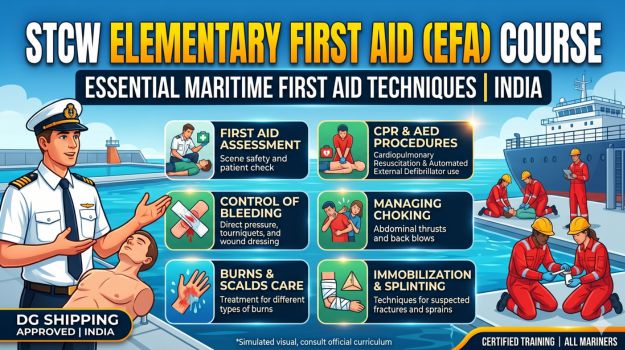
Stepping up your preparation on Nirzara, we bring you the EFA Exit Exam Mock - Questions and Answers Set 4. As you progress, the questions in the DG Shipping online portal become more technical. This set features 30 highly targeted Multiple Choice Questions (MCQs) that focus extensively on bone, joint, and muscle injuries, which are common risks in the physically demanding environment of a merchant ship.
In Set 4, you will encounter crucial questions regarding the identification of fractures, the correct use of splints, handling dislocations, and managing highly sensitive spinal injuries. Moving an injured crew member incorrectly can worsen their condition, which is why transport and rescue techniques are heavily tested in the STCW framework. Nirzara has meticulously structured these questions to reflect the exact framing, difficulty level, and options you will face in your actual computer-based test.
Every MCQ in this practice set is paired with its verified answer, serving as an instant self-assessment tool. By spending time on this quiz, you train your mind to spot the correct medical protocols under time pressure. Don't let confusing choices affect your score—use Nirzara's tailored practice material to clear your doubts, master the first-aid syllabus, and ensure a guaranteed pass on your upcoming DG Shipping exit exam!
Practice with 30 questions from the BASIC EFA COURSE bank. Each question is verified and explained.
MCQ Practice Questions (30)
Live Mock TestQuestion 1 / 30
Time Left: 15:00
Loading question...
🎉 Mock Test Complete
Your Examination Result
0 / 30
Score Percentage: 0%
Correct
0
Incorrect
0
Skipped
0
1
After fainting victim should lie down for 10 minutes
aNo
bYes
Correct Answer: Option B
Following a fainting episode, the casualty must remain lying down for at least ten minutes to ensure proper blood flow to the brain and to prevent further injury from a potential reoccurrence of dizziness or loss of consciousness, aligning with general maritime first aid protocols. This extended rest period allows for recovery and reduces the risk of immediate re-injury, a crucial aspect of onboard casualty care. This practice is a fundamental element of maritime safety training, emphasizing immediate post-incident management.
2
Drowning treatment required
aFirst aider advise
bDoctor advise
cSelf medication
dWill get cure automatically
Correct Answer: Option B
In marine safety and according to the principles of maritime medical care, immediate and expert medical advice is paramount for drowning victims. A qualified doctor's assessment and direction ensure appropriate, life-saving treatment, aligning with STCW and SOLAS provisions for medical assistance at sea. Other options lack the necessary medical expertise and do not guarantee effective intervention for a critical situation like drowning.
3
Treatment for strain is
aGive CPR
bRest and heat
cDrink more water
dWash the area
Correct Answer: Option B
For a muscular strain, the established maritime safety protocol, consistent with principles of first aid taught in STCW, prioritizes R.I.C.E. (Rest, Ice, Compression, Elevation) or in simpler terms, rest and the application of heat to promote healing and reduce discomfort, as outlined in standard maritime medical guidelines. Option B, "Rest and heat," directly addresses these recommended interventions for soft tissue injuries like strains, aiming to prevent further damage and facilitate recovery. Other options like CPR or simply washing the area are irrelevant to treating a musculoskeletal strain according to established marine safety and medical protocols.
4
First aid for heat exhaustion are
aMove him out of heat
bTo drink lot of water
cTo drink sports drink
dAll the above
Correct Answer: Option D
Heat exhaustion is a serious medical condition requiring immediate and comprehensive action; thus, the correct first aid involves removing the casualty from the heat source, encouraging fluid intake to rehydrate and replenish electrolytes, and the combined approach of all listed measures is paramount for effective treatment as per maritime medical guidelines.
5
For first degree burns keep the affected area in water for 5 to 10 minutes
aNo
bYes
Correct Answer: Option B
First aid for burns, as per maritime safety guidelines and STCW, requires immediate and sustained cooling of the affected area to prevent deeper tissue damage, making prolonged immersion in cool water for 5 to 10 minutes the correct procedure for first-degree burns. This process helps to dissipate heat, reduce swelling, and alleviate pain, adhering to established medical protocols for burn management at sea. The objective is to cool the skin effectively without causing hypothermia, ensuring the best possible outcome for the casualty.
6
For the third degree burns, you can keep the affected body in water
aYes
bNo
Correct Answer: Option B
The correct answer is "No." For third-degree burns, immediate immersion in water can cause hypothermia and further tissue damage due to the body's inability to regulate temperature, contrary to the treatment for minor burns. Standard maritime first aid protocols emphasize cooling only minor burns with copious amounts of cool, clean water and preventing heat loss for more severe injuries.
7
For the third degree burns, you can keep the affected body in water, in case of chemical burns
aYes
bNo
Correct Answer: Option B
Chemical burns require immediate removal of the chemical and specific decontamination procedures, not immersion in water which can exacerbate some chemical reactions, unlike thermal burns. Prolonged water immersion for chemical burns can spread the irritant or worsen tissue damage according to maritime safety protocols.
8
If wound on head, elevate the head
aYes
bNo
Correct Answer: Option A
For a wound to the head, elevating the head is a crucial first aid step to help reduce bleeding and swelling. This action aligns with general maritime safety protocols for managing head injuries, aiming to minimize further complications and support the casualty's recovery until professional medical attention is available.
9
Symptoms of Hypothermia are
aPale body
bUnconscious
cPulse weak
dAll the above
Correct Answer: Option D
Hypothermia, a dangerous drop in body core temperature, can manifest with a range of symptoms including pale skin due to reduced circulation, a weakened pulse as the body conserves energy, and ultimately, loss of consciousness as vital functions decline, thus Option D accurately encompasses all presented signs. Adherence to maritime safety protocols and understanding these critical physiological responses are paramount for crew well-being at sea, aligning with the principles of SOLAS and STCW.
10
Shellfish poisoning comes from
aEating red meat
bHalf boiled vegetables
cHalf boiled eggs
dContaminated shellfish
Correct Answer: Option D
Shellfish poisoning is caused by ingesting toxins produced by certain types of algae that accumulate in filter-feeding shellfish, a well-established food safety hazard addressed by general maritime health and safety protocols. Proper food sourcing and preparation are critical to prevent foodborne illnesses onboard vessels, aligning with the principles of safe and healthy working environments mandated by international maritime regulations. Therefore, consuming contaminated shellfish directly leads to this type of poisoning, making Option D the accurate identification of its source.
11
Continue rescue breathing until victim starts his own breathing
aYes
bNo
Correct Answer: Option A
Continue rescue breathing until the victim begins to breathe independently or a medical professional directs you to stop, as mandated by advanced first aid protocols to ensure adequate oxygenation and circulation. This aligns with maritime safety standards emphasizing the preservation of life until professional medical assistance can be rendered. The goal is to maintain vital functions until the body's own respiratory system re-establishes itself or definitive medical care is available.
12
Check the carotid artery for pulse on
aOn his chest
bSide of neck
cOn his leg
dOn his hand
Correct Answer: Option B
The carotid artery is a major artery located on either side of the neck, making it the primary location to check for a pulse in an unresponsive individual. This is a fundamental first aid principle mandated for all seafarers under STCW regulations to ensure rapid assessment of circulation in emergency situations. Checking the leg or hand for a pulse is less reliable and not the standard procedure for immediate life-threatening situations.
13
Burns on the face required
aFirst aider advise
bDoctor advise
cSelf medication
dWill get cure automatically
Correct Answer: Option B
Under maritime safety regulations, particularly STCW, serious burns on the face are considered a significant medical emergency requiring professional assessment and treatment. Therefore, "Doctor advise" is the correct response as it ensures appropriate medical expertise for diagnosis, management, and long-term care, preventing complications and ensuring the seafarer's well-being. Relying on self-medication or assuming automatic healing is contrary to best practices for casualty management at sea.
14
When a victim is having neck injury
aProvide additional pillow
bYou tilt his head for breathing
cYou should not tilt his head
dHold his head
Correct Answer: Option D
In cases of suspected neck injury, Option D, "Hold his head," is correct because immobilizing the head and neck is paramount to prevent further damage to the spinal cord, aligning with fundamental maritime first aid principles and safety protocols outlined in STCW. Options A and B are incorrect as they can exacerbate a neck injury, while Option C, while seemingly logical, is incomplete without the explicit instruction to actively immobilize the head.
15
Reason for diarrhea
aBacteria in water
bBacteria in diary products
cBacteria in vegetables
dAll the above
Correct Answer: Option D
Diarrhea onboard can be caused by various contaminants including bacteria present in contaminated drinking water, improperly handled dairy products, or unwashed vegetables, all of which fall under a broad scope of maintaining food and water safety as stipulated by maritime safety regulations to prevent outbreaks. Ensuring the integrity of potable water, the proper storage and preparation of all foodstuffs, and rigorous hygiene practices are critical for preventing such gastrointestinal illnesses in accordance with STCW and SOLAS requirements. Therefore, the most comprehensive and correct answer acknowledges that any of these sources, or a combination thereof, can lead to diarrhea among the crew and cadets.
16
Signs of shock are
aWeakness
bRapid pulse
cIncreased breath rate
dAll the above
Correct Answer: Option D
Shock is a life-threatening condition characterized by inadequate blood flow to vital organs, manifesting in multiple physiological signs; therefore, weakness, a rapid pulse, and an increased breath rate are all interconnected indicators of shock as per maritime first aid protocols mandated by STCW. Recognizing this constellation of symptoms is crucial for prompt and effective intervention, aligning with the overarching principles of marine casualty response and passenger safety outlined in SOLAS. The presence of any of these signs, and more critically, their combination, necessitates immediate management to prevent further deterioration and potentially fatal consequences.
17
Signs of food poisoning are
aDiarrhea
bCramps
cVomiting
dAll the above
Correct Answer: Option D
Food poisoning is a serious health hazard at sea, and its manifestations are multifaceted. Symptoms typically include gastrointestinal distress such as diarrhea, abdominal cramps, and vomiting. Therefore, recognizing all of these as potential signs is crucial for timely identification and management to ensure crew health and operational safety in accordance with maritime regulations.
18
While washing contaminated person you can use neutralizing agents
aNo
bYes
Correct Answer: Option A
Neutralizing agents should not be used when washing a contaminated person as they can exacerbate injuries or create new hazards by reacting with the contaminant; proper procedure involves immediate decontamination with copious amounts of water. This is in line with established maritime safety protocols and emergency medical response guidelines which prioritize dilution and removal of hazardous substances. Furthermore, SOLAS and STCW emphasize the importance of trained personnel and appropriate procedures for casualty care onboard vessels, which strictly exclude the use of potentially harmful neutralizing chemicals.
19
For the third degree burns
aCover the burn tightly
bCover the burn loosely with sterile gauze
cSupply more air to the wound
dAll the above
Correct Answer: Option B
Third-degree burns are severe injuries requiring immediate, appropriate first aid to prevent infection and promote healing. Covering the wound loosely with sterile gauze, as indicated by Option B, protects it from contamination without further damaging the tissue or restricting circulation, aligning with standard maritime medical protocols found in SOLAS and STCW guidelines for casualty care. Tight coverings (Option A) can increase damage and pain, while supplying more air (Option C) is detrimental to a burn wound as it increases the risk of infection and shock.
20
First aid is the initial stabilizing treatment
aYes
bNo
Correct Answer: Option A
First aid, as defined by international maritime conventions like STCW, is indeed the immediate care given to a casualty to preserve life, prevent the condition from worsening, and promote recovery until professional medical help arrives. This initial stabilizing treatment is fundamental to maritime safety and emergency response protocols.
21
You can give medicinal charcoal for Botulism
aYes
bNo
Correct Answer: Option A
Administering medicinal charcoal is a recognized first-aid measure for suspected food poisoning, including botulism, as it can bind to toxins in the digestive tract, preventing further absorption. While prompt medical attention is crucial, activated charcoal serves as an initial step to mitigate the effects of ingested toxins. This procedure aligns with general maritime medical guidelines to stabilize a casualty until professional medical help is available.
22
For critical burns, take victim to hospital
aNo
bYes
Correct Answer: Option B
Critical burns constitute a severe medical emergency requiring immediate, specialized treatment beyond the scope of onboard first aid facilities and trained personnel. Maritime safety regulations and the duty of care mandate that victims with such serious injuries receive professional medical attention ashore. Therefore, prompt evacuation and transfer to a hospital is an absolute necessity for proper treatment and to maximize the victim's chances of recovery.
23
Burns are described as
aFirst degree
bSecond degree
cThird degree
dAll the above
Correct Answer: Option D
Burns are classified into first, second, and third degrees, reflecting varying depths of tissue damage, as detailed in maritime first aid and emergency response protocols mandated by STCW. Understanding these distinct burn degrees is crucial for accurate assessment and appropriate treatment, ensuring compliance with marine safety standards for casualty care onboard. Therefore, all these classifications accurately describe burns in a maritime context.
24
If the victim is having convulsion
aDo not give any thing
bLay the victim down
cProtect his head and body
dAll the above
Correct Answer: Option D
In the event of a victim experiencing convulsions at sea, immediate action must prioritize safety and stabilization according to established maritime first aid protocols, aligned with principles of STCW. Therefore, "Do not give any thing" prevents aspiration, "Lay the victim down" minimizes injury from falls, and "Protect his head and body" shields against impact, making Option D, "All the above," the correct and comprehensive response to ensure the victim's well-being.
25
Symptoms of botulism
aSlurred speech
bDisturbed vision
cBreathing difficulty
dAll the above
Correct Answer: Option D
Botulism is a serious neuroparalytic illness caused by the toxin of *Clostridium botulinum*, and its symptoms include the neurological effects of slurred speech, disturbed vision, and difficulty breathing, all of which are indicative of this severe intoxication and require immediate medical attention. These symptoms collectively represent the progression of neuromuscular impairment characteristic of botulism poisoning, a critical consideration for maritime safety and the well-being of seafarers under STCW provisions. Understanding these signs is vital for prompt response and effective casualty management in a maritime environment.
26
Asphyxia occurs when a person cannot get enough
aHydrogen
bNitrogen
cCarbon dioxide
dOxygen
Correct Answer: Option D
Asphyxia is a condition arising from a severe lack of oxygen in the body, preventing vital organs, particularly the brain, from functioning. Marine safety protocols, as outlined in SOLAS and STCW, emphasize the critical need for adequate oxygen supply in enclosed spaces and during emergency situations to prevent this life-threatening state. Therefore, the correct answer is that asphyxia occurs when a person cannot get enough oxygen.
27
Toxic gas instrument measures the expected gas presence
aIt gives the measurement of oxygen
bIt gives measurement of hydrogen
cYes
dNothing above
Correct Answer: Option C
A toxic gas instrument, as per SOLAS and STCW requirements for enclosed spaces, *does* measure expected gas presence, and often this includes oxygen deficiency as well as the presence of toxic gases like hydrogen sulfide. Therefore, the statement that it measures expected gas presence is correct, making Option C the appropriate answer. This functionality is critical for ensuring the safety of personnel entering potentially hazardous atmospheres onboard vessels.
28
After removing victim from electrical shock
aLay down on flat surface
bCheck for breath
cCheck for pulse
dAll the above
Correct Answer: Option D
Following a casualty's removal from an electrical shock, as per maritime safety and first aid protocols aligned with STCW standards, it is imperative to immediately assess their condition comprehensively. This involves ensuring they are positioned safely on a flat surface to facilitate effective intervention, then promptly checking for signs of respiration and cardiac activity by verifying for breath and pulse. All these steps are critical for determining the next course of action in administering potentially life-saving aid.
29
SCBA means
aSecured contained breathing apparatus
bSelf contained berthing apparatus
cSelf contained breathing apparatus
dSelf cooling breathing apparatus
Correct Answer: Option C
SCBA stands for Self-Contained Breathing Apparatus, as defined by SOLAS Chapter II-2 and STCW Code. This equipment provides an independent supply of breathing air essential for survival and rescue operations in hazardous atmospheres encountered on board vessels. Therefore, Option C is the correct definition of SCBA in maritime safety regulations.
30
If wound on leg, elevate leg
aYes
bNo
Correct Answer: Option A
Elevation of a wounded limb aids in reducing blood flow and swelling, a fundamental principle of first aid to mitigate further injury and promote healing, consistent with maritime safety protocols for casualty management. This action helps to control hemorrhage and manage shock effectively until professional medical assistance can be rendered, aligning with STCW and SOLAS mandated safety practices.
About Me
NIRZARA TEAM
Author & Contributor
The Nirzara Team is a group of dedicated marine professionals and educators committed to improving maritime learning through digital education. Our team works to provide quality study materials, practical knowledge, and career guidance to support seafarers and marine students worldwide.